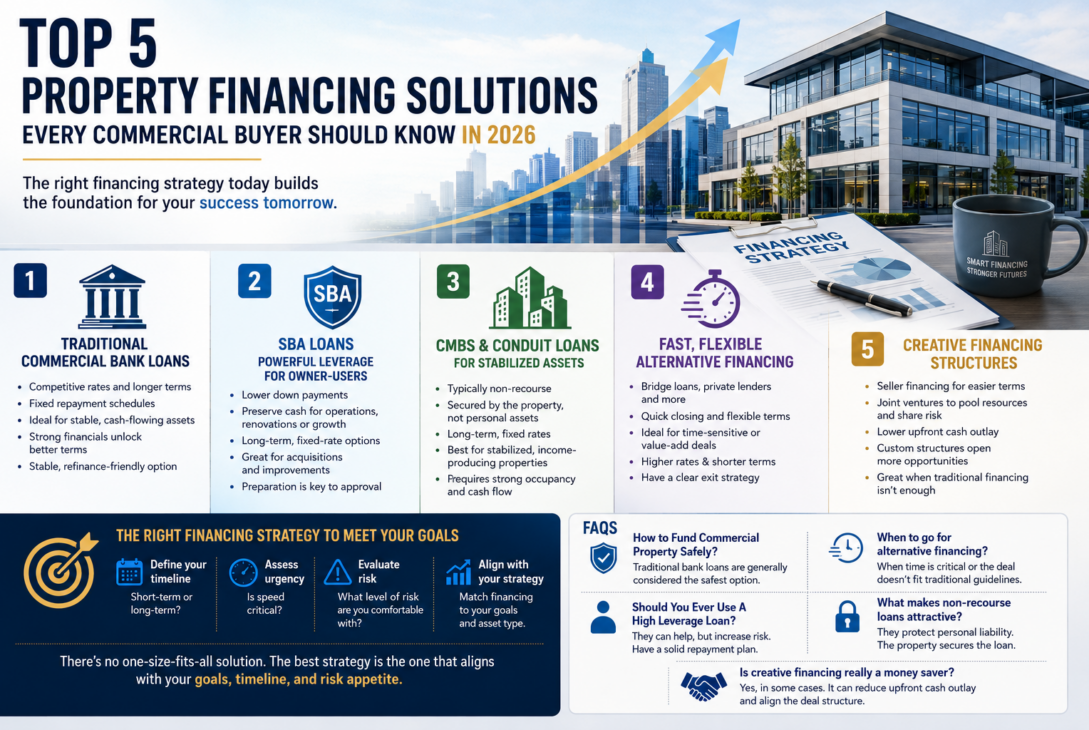
So you are walking into commercial real estate in 2026, here’s the deal: you can find a property that’s 50% of the game. The real benefit comes from knowing how to finance it appropriately. How the structure of the loan will affect you over time, and choosing the right structure vs. the easiest loan, is the difference between a good deal and a great deal.
This is where property financing solutions come in. As more options are offered in today’s market, so too has the complexity of that flexibility increased. And each route to financing comes with its risks, timing, and eternal impact. Matching your financing with your strategy from the outset sets you up to move faster, negotiate hard, and scale wisely.
Let us explain the five most critical financing options every commercial buyer should understand today.
Traditional Commercial Bank Loans Remain the Market Leader
Despite innovations in lending, traditional bank loans remain the mainstay of commercial real estate finance. They are stable and orderly, with a common understanding, which makes them a highly preferred buy for many customers.
Such loans have longer terms, competitive interest rates, and fixed repayment schedules. It’s often the most straightforward financial structure when purchasing a stable, income-producing property. This is particularly suited to cash-flowing assets, the kind where lenders are generally more assured of repayment.
To be fair, banks in 2026 are picky. As lenders scrutinize your debt-service coverage ratio, operating income, and history, solid financials are more important than ever. The upside? If you go in prepared, you’ll get better terms, such as lower rates and better prepayment terms.
This is not the fastest option, but it is one of the most stable and refinance-friendly options available.
SBAs Unlocks the Power of Leverage for Owner-Users
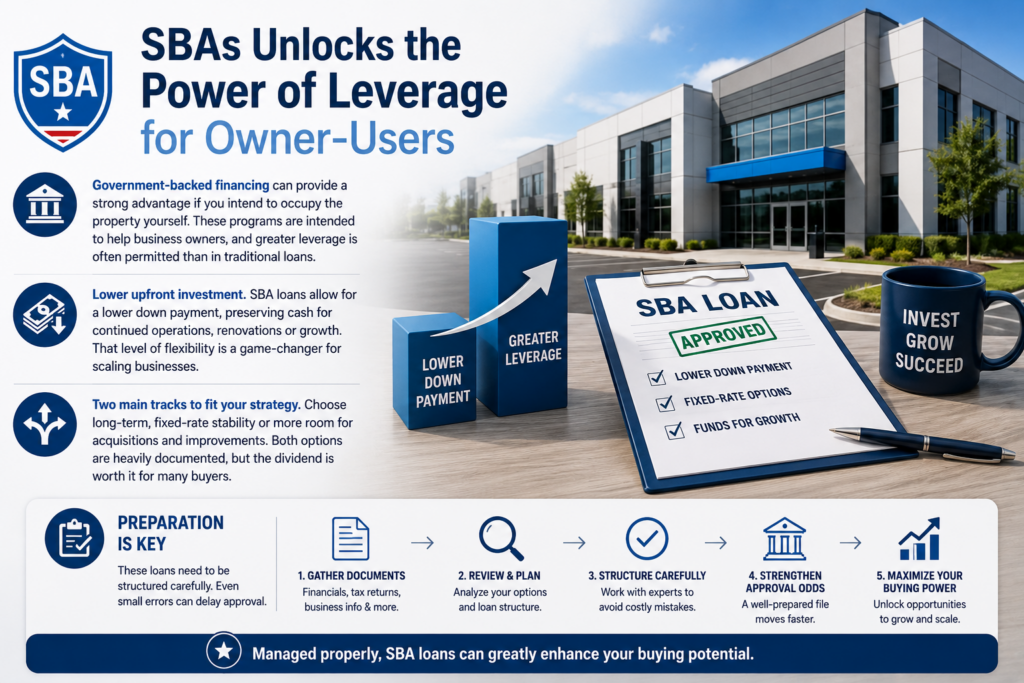
Government-backed financing can provide a strong advantage if you intend to occupy the property yourself. These programs are intended to help business owners, and greater leverage is often permitted than in traditional loans.
The lower upfront investment is the main reason these loans are attractive. This allows you to purchase a piece of property with a lower down payment, preserving cash for continued operations, renovations or growth. That level of flexibility is a game-changer for scaling businesses.
In this space, there are usually two main tracks—long-term, fixed-rate stability and more room for acquisitions and improvements. They’re both heavily documented, but the dividend is worth it for many buyers.
The key here is preparation. These loans need to be structured carefully, and even small errors can delay approval. Managed properly, however, they can greatly enhance your buying potential.
CMBS and Conduit Loans for Stabilized Assets
Conduit financing is increasingly relevant to buyers focusing on stabilized, income-producing properties. Unlike traditional bank loans, these loans typically have a different structure and underwriting approach, generally placing less emphasis on a borrower’s individual balance sheet and more on the property itself.
For starters, they are usually non-recourse, which is one of their biggest benefits. It also means the loan is secured against the property, not your personal assets. This can be a game-changer for investors, dramatically lowering personal risk.
They also offer a long-term suite of fixed rates, which can be attractive in uncertain markets. The flip side is a more stringent underwriting. Lenders look for good, clean financials, good occupancy, and solid cash flow.
This form of financing is ideal when the property is already stabilized. And while that makes it less flexible than other options, it can provide stability and favorable long-term terms for the right asset.
Fast, Flexible Alternative Financing
There are some deals that they cannot stretch to fit the traditional lending box. Perhaps you need to be fast, or your project does not meet strict underwriting requirements. And this is how alternative financing comes into play.
Private lenders, bridge loans, and a few others with more flexible funding sources fall into this category. The above options are meant to be closed quickly and accommodate special circumstances. Mostly, they are ideal for time-sensitive transactions, value-add projects, or the repositioning of properties.
The benefit is speed and flexibility. You can get funded without going through the time-consuming approval process of traditional lenders. The downside? Higher interest rates and shorter repayment terms.
This means you need an explicit exit strategy. Alternative financing used tactically will permit you to visit places that are solely closed.
Creative Financing Structures Expand Opportunities
The best deals sometimes do not come from normal loans at all. The flexibility that creative financing structures provide can often make or break a deal in competitive markets, and therefore, they are becoming more commonplace.
Seller financing is one example. In this scenario, the seller is acting as the lender and is providing terms that may be easier than those of a traditional bank. This makes negotiations easier and reduces the need for upfront costs when the seller is willing to do so.
Joint ventures, too, are a formidable option. Working with an additional investor allows you to pool resources, share risk, and gain entry to opportunities you may not have without the association. One party could provide capital, while another provides expertise or the “ground game” of running things.
These create structures that communicate and have the right agreements, but leverage this residual value. They are most effective when traditional financing is not enough, or when you want to move faster to scale.
The Right Financing Strategy to Meet Your Goals
The largest struggle is not the access; there are tons of options available, but in their alignment. What to consider when financing your property. The best financing strategy is the one that aligns with your goals, timeline, and risk appetite.
Begin asking yourself a few fundamental questions. Is it long-term or short-term only? Is the speed critical, or can you live with an extended approval cycle? What level of risk are you comfortable with?
Your answers will lead to your choice. While traditional financing could be beneficial for a stable, income-generating property, a value-add project may need a more creative approach. And that is precisely why knowing your options is so important; there is no catch-all solution.
Financing this way is not merely about funding a new purchase; it is a means of laying the groundwork for expansion in the years to come.
FAQs
How to Fund Commercial Property Safely?
Traditional bank loans are generally considered the safest form of financing since they offer more familiar terms and lower interest rates.
When to go for alternative financing?
Alternative options are beneficial in scenarios such as when time is of the essence or when a deal does not meet conventional lending guidelines.
Should You Ever Use A High Leverage Loan?
These can be helpful (as long as they are not mismanaged, which can increase risk), but they also necessitate a solid repayment plan.
What makes non-recourse loans attractive?
They protect personal liability. The property, not personal assets, secures the loan.
Is creative financing really a money saver?
Yes, in some cases. Economy Terms and Risk Share: Reduces the high initial cash outlay and aligns the deal structure as a whole.