By 2026, your website is more than an online brochure; it’s your most valuable sales tool. As AI search, zero-click results, and ever-increasing user expectations take center stage, your corporate website design needs to be more than just great-looking. The user experience must flow easily from intrigue to conversion.
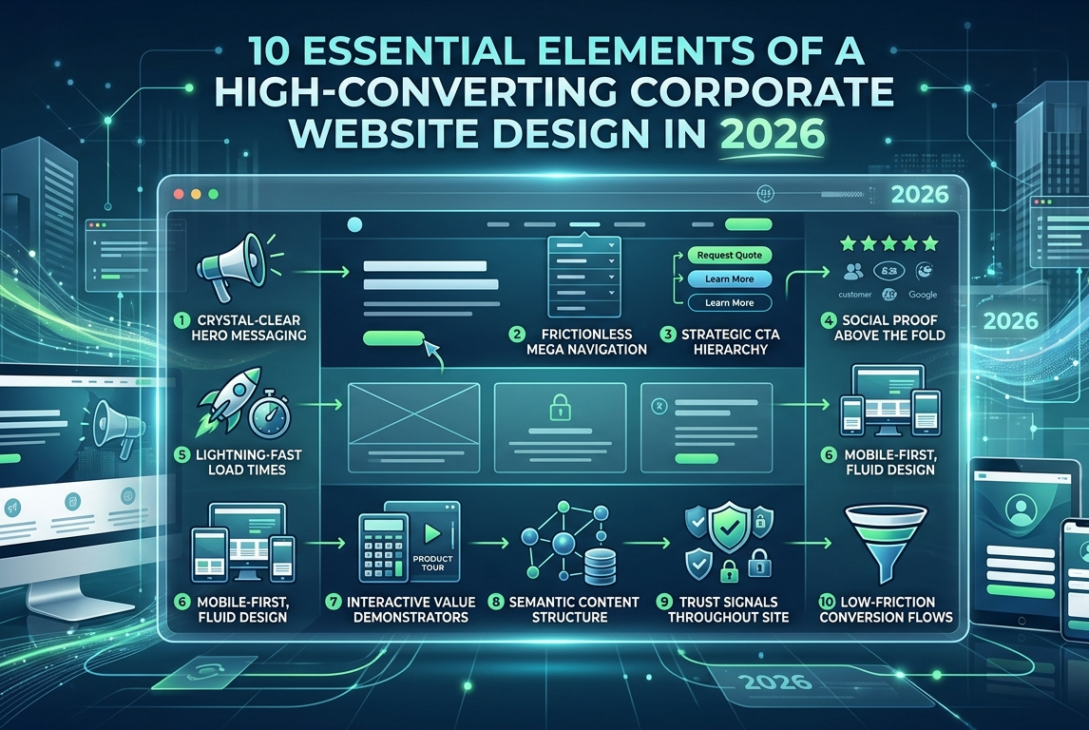
Combining speed, psychology, and usability, a high-performing corporate site provides an experience that blends the best of three worlds. These are the ten things that constantly differentiate average websites from lead-generation, trust, and revenue-generating websites.
- Crystal-Clear Hero Messaging
It takes visitors seconds to decide if your site is of interest to them. This is why the hero — the above-the-fold section of your site should instantly convey what you have to offer.
Your headline needs to point to a clear business pain point, and your subheadline should drive credibility with proof points or results. Follow that with a clear call to action so visitors have a straight path forward.
Vague taglines dilute engagement. No surprises there, direct, benefit-driven messaging keeps bounces low and explorative behavior higher up the funnel.
- Frictionless Mega Navigation
Corporations have a lot of content to cover on their sites, including services, solutions, case studies, and resources. Seeing the users become flustered by the process of using it without any organized framework is very common.
Mega navigation menus ease some of this complexity by presenting categorized links in a scannable format. In addition, sticky headers and breadcrumb trails help users know where they are on the site and return to key sections without confusion.
If visitors can quickly find what they want, they are much more likely to stay and convert.
- Strategic Call-to-Action Hierarchy
Some visitors are not yet ready to sign up for a demo or a consultation. This is why high-converting sites will have layered calls to action suited to the different stages of the buyer journey.
Core actions, such as scheduling a meeting or requesting a quote, should be highly visible and consistent across your key pages. Secondary options, such as the ability to download guides or start a chat, keep engagement high without pushing the user.
Ensures the path of each visitor to the destination with the right Intent with a structured approach of CTAs
- Social Proof Above the Fold
Online Decision-Making: The Greatest Barrier Is Trust. Corporate sites that feature positive experiences, customer logos, ratings, or performance assurances at the outset of the browsing experience engender trust almost immediately.
When a visitor notices that your services have helped other organizations, the visitor’s risk increases significantly. Letting customers share their success stories and showing actual results builds confidence in your credibility.
- Lightning-Fast Load Times
Speed is no longer a technical indicator; it is a conversion factor. Visitors leave pages that take longer than a few seconds to load without ever seeing any content.
Well, your images are optimized, your code is minified, and it is hosted on a fast server, so your site is at least relatively close to a standard these days. Pages that load quickly not only help Google realize that people prefer your web pages and that they are part of a good user experience, but also serve as a ranking factor for good search engine visibility.
An agile, fast site conveys professionalism and confidence to visitors and search engines alike.
- Mobile-First, Fluid Design
Given that most of the traffic comes from a mobile device, smaller screens need to be designed for. Corporate sites must be responsive across smartphones, tablets, and desktops, without sacrificing readability or functionality.
To put it differently, mobile users are more straightforward in their interactions, preferring touch-friendly buttons, simplified layouts, and vertically structured content. A really effortless experience on mobile is a great way to grow your brand and keep users around longer.
- Interactive Value Demonstrators
Modern users seek to experience value rather than just read about it. Things like calculators, product tours, or configurators allow visitors to get a little more hands-on, and you clearly explain how your offerings work.
Such tools increase time spent on the site and help prospects visualize the results, thereby increasing the likelihood of moving on to the next stage. Features like hover animations and guided transitions enhance usability by drawing attention to the most important actions.
- Semantic Content Structure and Topic Clusters
Search engines and AI assistants use high-quality content with a clear structure to fetch your information. Grouping pages into topic clusters that are interlinked enhances usability and search visibility.
Use headings, clear data format, and group your services logically so search engines can understand your subject expertise. It adds to your authoritative status and boosts your chances of appearing in rich results or AI-generated text summaries.
- Trust Signals Throughout the Site
Do not limit yourself to testimonials alone; remember that corporate websites need trust reinforcement at every touchpoint. Elements such as a security badge, a compliance badge, and privacy assurance visible in the headers help visitors feel secure about entering their personal or business information.
Contact information, professional validations, and clear policies to gain confidence that you are dealing with the right organization. Trust signals, in abundance, reduce distrust and make forms easier to fill.
- Low-Friction Conversion Flows
Conversion is the last step of any high-converting website. Even if they are interested, long, complicated forms will probably deter them from completing an inquiry.
Using progressive forms to gather information over time, along with minimal fields, clear instructions, and continued engagement, greatly enhances completion rates. Even thank-you pages can be optimized to guide users to other resources while keeping them on your site after submission.
Every single step ought to be intuitive, pure, and as anticipated by the user.
Frequently Asked Questions
What is a high-converting corporate website?
The best-performing corporate websites are centered on user experience, clear messaging, high performance, and high conversions driven by the placement of calls to action. Together, these components help compel the visitor to take meaningful action, such as contacting the company or requesting service.
How frequently should a corporate site be updated?
A design refresh every three to five years is helpful for most corporate sites. Performance, content, and user flow, on the other hand, should be reviewed continuously to ensure the site keeps up with the latest requirements of the digital world.
Still make sure your website is optimized for mobile in 2026?
Indeed, a mobile-friendly approach has never mattered more. Since most users browse on their smartphones, most potential leads will bounce from a poorly optimized mobile site.
Why is website speed important to conversions?
A faster website offers a better browsing experience, less user frustration, and a higher likelihood that users will view more pages. If the load times are slow, there is a higher chance of visitors bouncing from the site, which means lower conversion performance.
Does anything interactive truly make a difference to engagement?
Interactive components enable users to engage with services and gain insights about what they could look forward to.
Create a Site That Leads Every Visitor To Take Action
A corporate website that converts does not revolve around trends or eye candy; it revolves around behavior. Each part, from the hero banner to the contact form, needs a purpose that helps visitors understand your value and take the next step.
Together with concise messaging, simple navigation, fast page load times, and high trust signals, organizations can turn these sites into lead-generating machines that provide analytical entry points to inform marketing efforts that work well past launch.