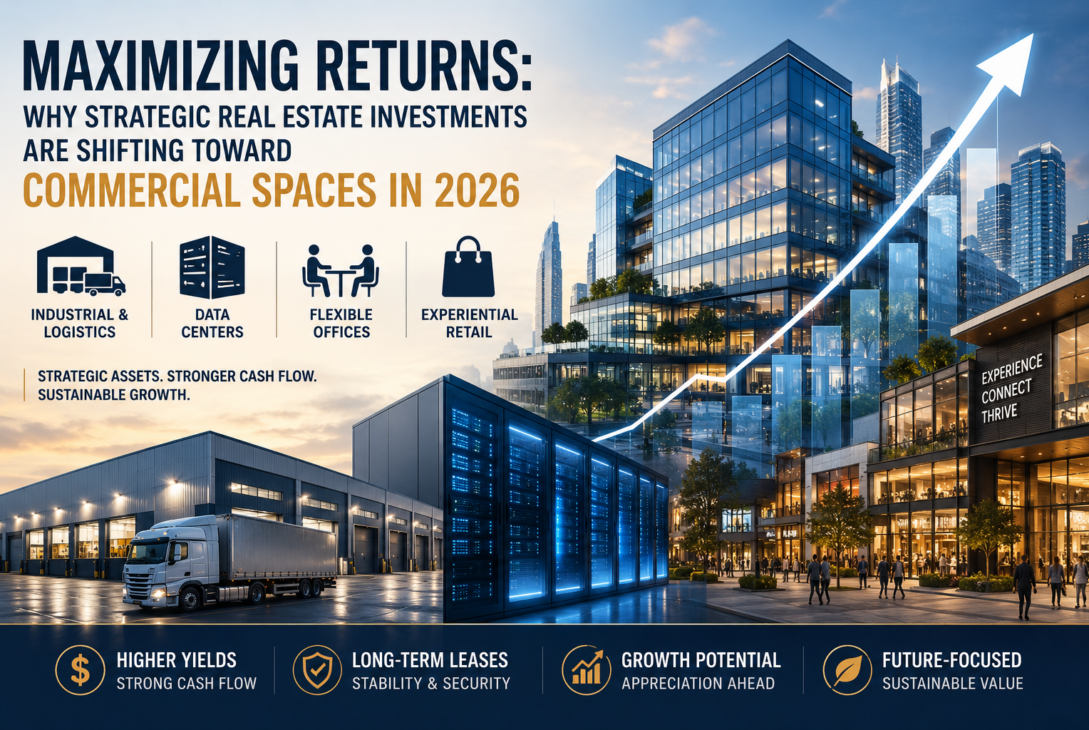
The property market worldwide is entering another stage in 2026, and investors are changing their approaches. Residential property has traditionally been viewed as the less risky and more familiar option, but market forces are driving capital toward commercial property. Nowadays, real estate investments are increasingly concentrated in logistics, data infrastructure, flexible offices, and experiential retail, which prove to be more resilient and yield greater profits in the long run.
It is not a coincidence that this change is occurring. The economic situation, technological evolution, and evolving customer behavior drive it. The commercial properties are proving more aligned with these new trends, providing investors with stable cash flow and appreciation.
The reason why Commercial Properties are doing better than Residential Properties
Residential houses have been experiencing strain due to the increased cost of borrowing, declining rental demand in certain areas, and increased housing supply. As a result, the housing industry has seen a moderation in returns, making it less appealing to investors who depend on stable earnings and growth.
Structural demand, on the other hand, is benefiting commercial assets. It is still required that businesses have warehouses and data storage centers, office teamwork areas, and storefronts integrated with online shopping. These are not cyclical needs, as housing demand is usually affected by interest rates and people’s affordability.
Industrial and Logistics Properties: Thumbs up to E-Commerce
Industrial real estate, especially logistics and distribution facilities, is one of the best-performing commercial segments in 2026. The idea of online shopping has led to a continuous increase in the need to create facilities, such as warehouses and last-mile delivery centers, in the modern world.
Retailers and logistics companies are spending heavily on facilities that enable faster delivery and automated order fulfillment. High ceilings, high-level loading facilities, and proximity to transportation systems are attracting high rents and resulting in low vacancy rates.
These properties render industrial assets appealing to investors seeking stable cash flow, stable tenancy, and long lease terms.
Data Centers: A High-Growth Opportunity Driven by Technology
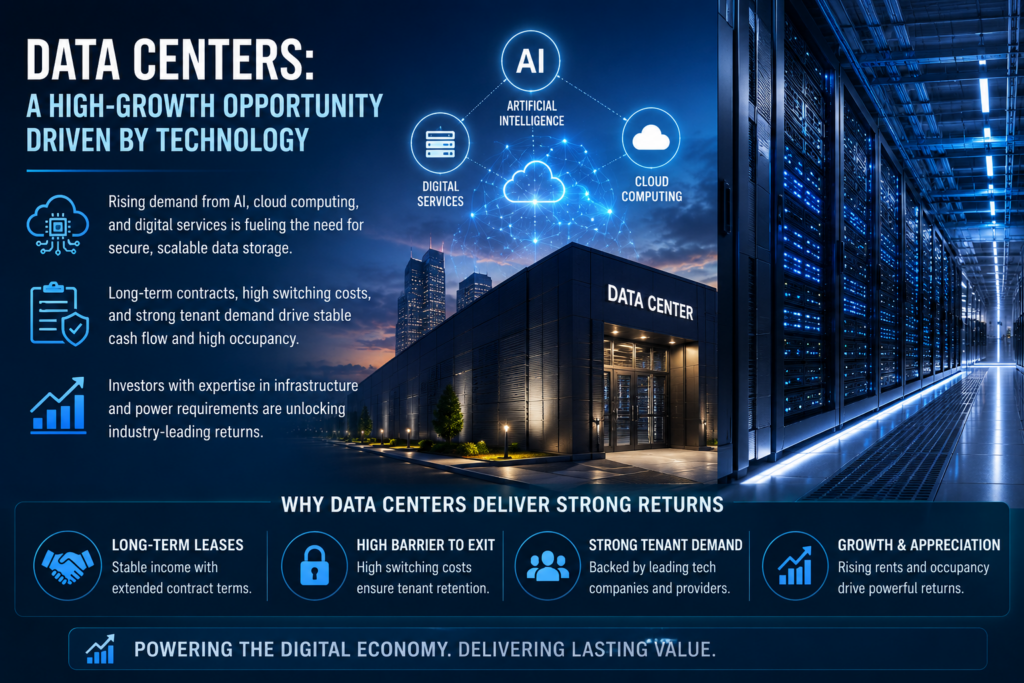
The increasing demand for data centers is another significant force of commercial investment growth. With the continued growth of artificial intelligence, cloud computing, and digital services, the need for safe and scalable data storage has increased significantly.
Data center properties offer a distinct set of benefits, such as long-term contracts, high switching costs for tenants, and steady demand from technology companies and service providers. These will help increase rental growth and occupancy rates.
Data facility investors who are knowledgeable about the infrastructure and power demands of their data centres are discovering that this industry has some of the best returns in the business property market.
The Evolution of Office Spaces and the Flight to Quality
Although the real estate needs for this office have been uncertain due to remote work in recent years, the industry is now recovering and establishing a clear pattern: companies are focusing on quality rather than quantity.
Organizations are not continuing to maintain a large footprint in old buildings, but are moving into spaces designed to facilitate hybrid work and collaboration.
The flexibly planned office buildings, efficient ventilation systems, wellness programs, and digital opportunities are attracting tenants who can afford to pay high rents. The performance of buildings that can be used to share facilities and adapt to changes in leasing is better than that of older, less flexible buildings.
This change is opening up opportunities for investors, with an emphasis on quality office properties or the reclassification of older ones to suit new workplace demands.
Retailing Is Recoverying With Experience and Convenience
Retail property is also transforming and not dying out. Brick-and-mortar is being reconceptualized as an experience that will be used in complement to online shopping. Consumers are becoming more demanding, expecting to run errands, place online orders, dine, and enjoy entertainment in one place.
Essential service-based anchored properties or mixed-use properties are showing higher foot traffic and tenant retention. Retail assets that are shaped by lifestyle and convenience trends are proving to be regaining their value and providing stable income to investors.
The Economic Stability in the Growth of Commercial Investment
In 2026, macroeconomic conditions are contributing significantly to commercial property activity. The rate of inflation has been stable compared with past years, and interest rates are beginning to stabilize. This has enhanced investor confidence and the predictability of financing.
Institutional and private investors are also returning to the commercial market with greater confidence in market costs and direction regarding borrowing. There is also increased transaction activity and competitive bidding for high-quality assets, further enhancing the perception of commercial real estate as a robust asset class.
Risk Management and Diversification in the Commercial Sectors
As much as there are good prospects for commercial real estate, investors who succeed appreciate the value of diversification. Diversifying capital across multiple property types, such as industrial, office, retail, and specialized infrastructure, may help mitigate risk and ensure stable income streams.
Long-term leases with built-in rent increases, rigorous tenant screening, and attention to local economic drivers are critical measures to mitigate exposure to market volatility. Sustainability levels and regulatory adherence are also receiving greater focus from investors because properties that achieve environmental and efficiency targets have better retention rates.
The role of Technology in revolutionizing commercial property investment
The use of technology in the evaluation, management, and optimisation of commercial properties is increasing. High-level analytics tools enable investors to evaluate tenant demand, predict occupancy patterns, and determine underperforming assets more accurately.
Smart building systems, such as automated energy control and occupancy detection, are also contributing to the reduction of operation expenses by property owners, and tenant comfort.
Frequently Asked Questions
The question is, why are investors abandoning residential properties in 2026?
Increased borrowing costs and low growth in rental and housing supply have made residential properties less profitable in certain areas.
Are residential properties more secure than commercial properties?
Commercial properties may require a larger initial investment and involve more complex management; however, they tend to have longer lease periods and higher rental rates.
Which business area is currently the most promising?
Industrial logistics and data infrastructure are commonly considered the fastest-growing sectors due to the growth of e-commerce and the increased use of digital data
What is the average duration that investors should invest in commercial properties?
Most investors use a medium to long-term holding strategy, usually between five and ten years. This period allows them to enjoy rental increases, property appreciation, and prospective cyclical gains in the market.
Does it mean that commercial properties need to be proactively managed?
Yes, commercial property tends to need additional lease negotiation, maintenance planning, and tenancy relationship management. Nevertheless, these roles can be handled by professional property management services, allowing investors to concentrate on strategic decisions.
Placing Portfolios on the Next Level of Property Development
Since the real estate environment keeps changing, investors who adapt their strategies to suit the evolving market are better positioned to seize new opportunities. The modern investment portfolio is slowly shifting toward a focus on commercial properties, driven by technological growth, changes in consumer behavior, and the stabilization of economic conditions.
Investing in the property market, it is possible to match the portfolio with the areas that show the most resistance and potential of the future returns, which can be achieved through grasping the trends and concentrating on the high-quality assets and remaining diversified.