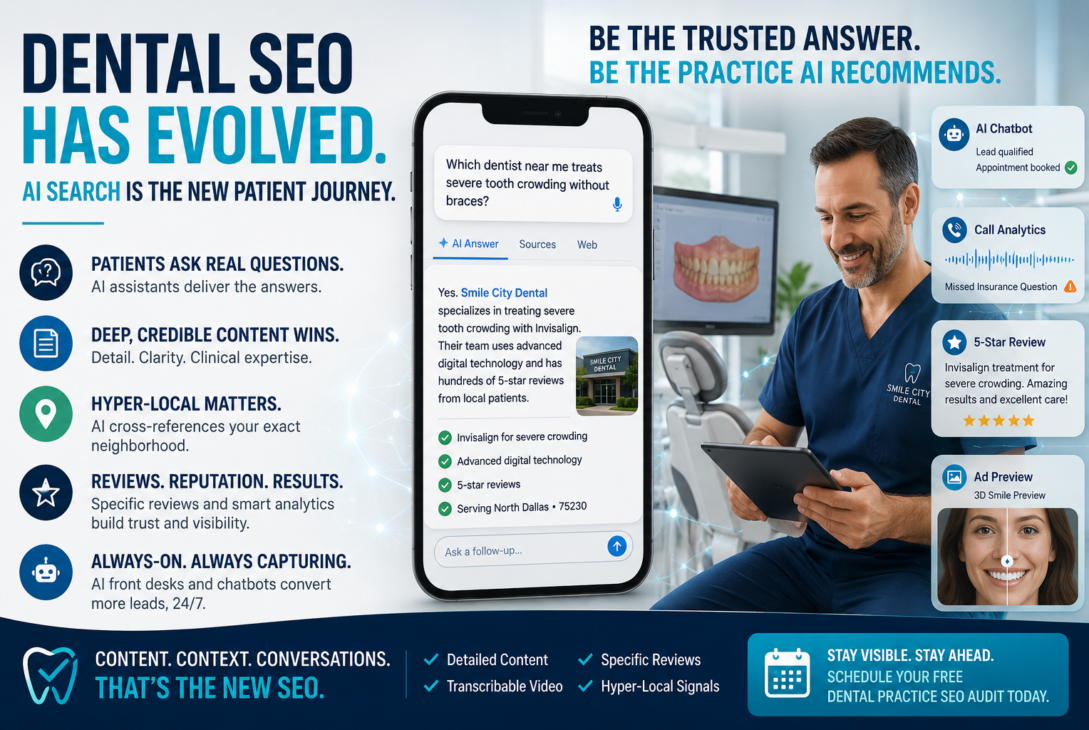
Patients no longer type three lazy words into Google and scroll through ten blue links. They ask full questions to ChatGPT, Gemini, and Perplexity, and they expect a real answer, not a list of ads. That single change is rewriting the rules of dental practice SEO from the ground up.
For years, ranking well meant repeating the right keywords in the right places. That still matters, but it’s no longer enough. AI-powered search engines now reward practices that provide deep, credible, well-organized answers across every platform they touch: the website, social media, directories, and review sites alike.
Here’s what’s actually changing, and what your practice needs to do about it.
The practices that adapt now will show up as the trusted answer when a patient asks an AI assistant where to go. The ones that don’t will simply become invisible, no matter how good the clinical work is.
The Shift From Traditional SEO to AI Search Visibility
Traditional dental practice SEO focused on stuffing a handful of keywords onto a static webpage and hoping Google noticed. That approach is fading fast.
Modern patients use conversational, detailed searches like “which dentist near me treats severe tooth crowding without braces” instead of short fragments like “dentist crowding.” AI search engines are built to understand and answer exactly that kind of question.
This matters because AI tools like ChatGPT, Gemini, and Perplexity don’t just rank pages; they read them, summarize them, and decide whether they’re worth citing. A page that reads like a genuine answer from a knowledgeable dentist has a far better shot at being that citation.
Conversational Intent
Patients now phrase searches as full questions, so your content needs to answer real questions in plain language, not just target isolated keywords.
Information Density
AI models favor pages that explain a topic thoroughly. A page with genuine clinical depth will consistently outperform a thin page stuffed with repeated phrases.
Hyper-Local Context
AI engines cross-reference your exact neighborhood, not just your city. A practice in a specific ZIP code or district should say so clearly and often.
Why Vague Social Captions No Longer Work
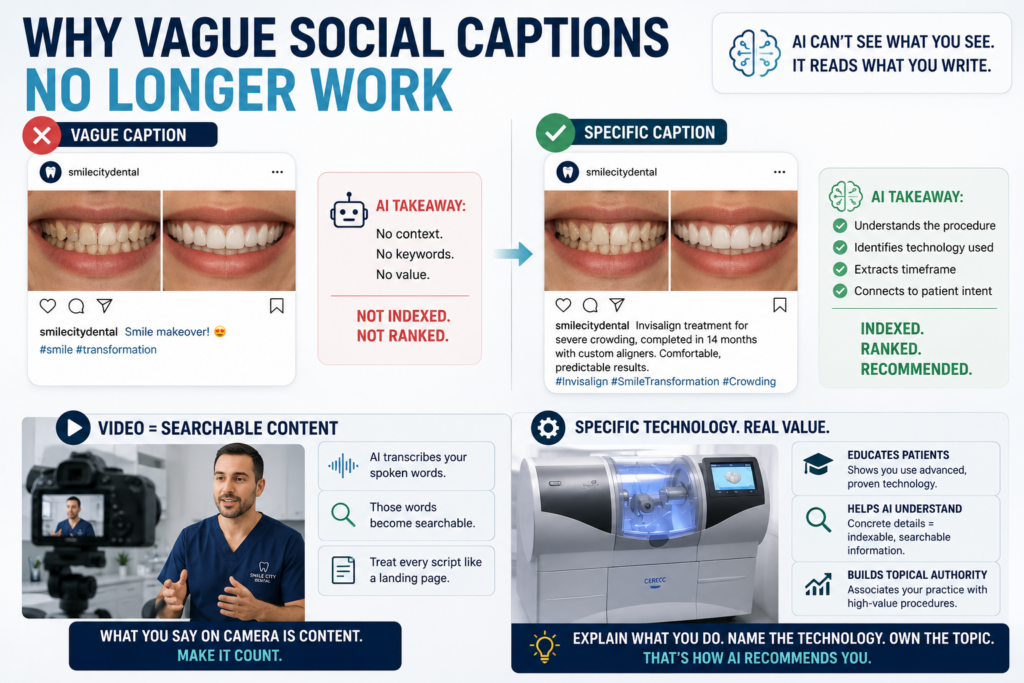
AI cannot interpret a photo the way a human eye can. A stunning before-and-after smile transformation has zero SEO value to an AI model unless the caption explains what actually happened.
A caption like “Smile makeover! 😍” tells an algorithm nothing. A caption describing “Invisalign treatment for severe crowding, completed in 14 months” tells it all.
The same logic applies to video. AI systems automatically transcribe spoken audio, which means the words your team says on camera are now searchable content. Treat every video script with the same care you’d give a landing page.
Mentioning the specific technology involved, such as a CEREC system used for same-day crowns, does double duty: it educates the patient and gives AI models a concrete, indexable detail to associate with your practice.
24/7 Virtual Front Desks Are Becoming the Norm
Practices are increasingly using AI chatbots and virtual receptionists to catch leads that would otherwise be lost after hours or during busy front-desk moments.
These tools qualify new patients, answer basic clinical questions, and book appointments automatically, often syncing directly with practice management systems like Dentrix or Open Dental.
The result is fewer missed calls, shorter hold times, and a patient acquisition funnel that never technically closes for the night.
Reputation and Call Analytics Are Getting Smarter
AI-driven marketing tools now look past star ratings to measure the substance behind them.
Review platforms encourage patients to mention specific procedures by name, which strengthens both credibility and local relevance. Owner responses can be optimized in the same way.
On the phone side, AI can analyze recorded front-desk calls to flag where staff are losing potential patients a missed insurance question, a slow callback, an unclear pricing answer so practices can fix leaks in the funnel before they cost a new patient.
This kind of visibility used to require a full call center audit. Now it happens automatically, giving practice owners a running scorecard of exactly where their marketing dollars are succeeding or failing.
Advertising Is Becoming Hyper-Personalized
Paid dental advertising is moving away from broad, one-size-fits-all campaigns toward machine-built patient avatars.
A middle-aged patient researching implant financing sees different messaging than a parent researching early orthodontic screening because AI systems can now group audiences by intent, not just demographics.
Some practices are even using AI-generated 3D smile previews in ads, giving prospective patients a visual sense of their results before they ever sit in the chair.
What This Means for Your Practice’s SEO Strategy
None of this replaces the fundamentals of dental practice SEO: a fast, mobile-friendly website, an accurate Google Business Profile, and consistent local citations are still the foundation on which everything else is built.
What’s changed is the layer on top of that foundation. Content now needs to be written for a machine that’s trying to genuinely understand and summarize it, not just index a keyword.
Practices that adapt early with detailed content, transcribable video, specific reviews, and always-on patient response systems are the ones AI search engines will keep pointing patients toward.
Final Thoughts
AI hasn’t replaced dental marketing; it’s raised the bar for what good marketing looks like. Practices that keep writing thin, keyword-stuffed pages will quietly disappear from AI-generated answers. In contrast, practices that invest in genuine clinical depth, hyper-local detail, and responsive patient communication will be the ones AI recommends by name.
If your website, social content, and review strategy haven’t been updated for this shift, now is the time. A dental practice SEO audit can show you exactly where the gaps are and how to close them before your competitors do.
The dentists who treat this shift seriously today will be the names AI assistants recommend tomorrow, and that’s a competitive advantage worth acting on now, not next year.