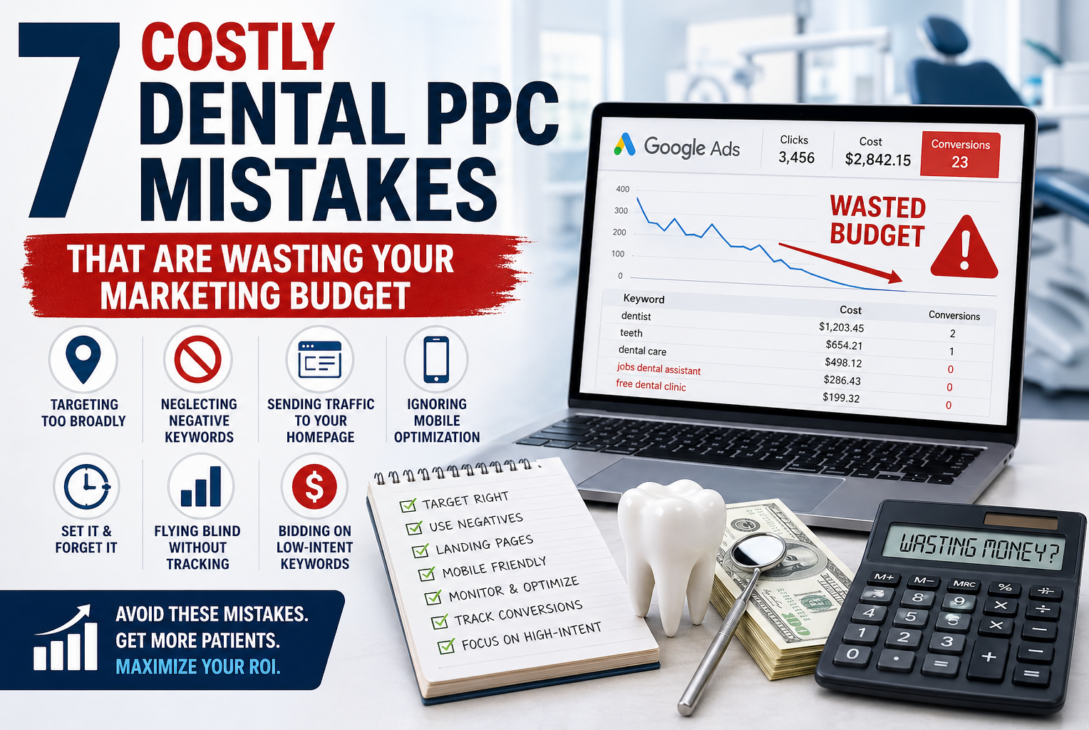
You’re spending real money on Google Ads, but are those clicks actually turning into patients? For many dental practices, the honest answer is no. Dental PPC (pay-per-click) advertising can be one of the most powerful tools for growing your patient base. But without the right setup, it becomes an expensive way to fund your competitors’ waiting rooms.
Below are seven costly dental PPC mistakes that drain marketing budgets, and exactly how to fix each one. Whether you’re running campaigns in-house or working with a dental marketing agency, avoiding these pitfalls can dramatically improve your return on ad spend.
Mistake #1: The Radius Trap — Targeting Too Broadly
One of the most common mistakes in dental PPC is setting a generic 15-to-20-mile radius around the practice and calling it a day. On paper, more coverage sounds better. In reality, most patients will not drive more than 10–15 minutes for a routine cleaning or checkup.
In dense urban areas, a broad radius means your ads appear to people several suburbs away, users who will click, see your address, and bounce. You’ve paid for a click that was never going to convert.
The Fix
Use precise geo-targeting and focus on the specific zip codes or neighborhoods closest to your practice. Google Ads allows you to adjust bids by location, so you can pay more for clicks from your immediate area and less (or nothing) for those farther out.
Mistake #2: Neglecting Negative Keywords
Negative keywords are one of the most underused tools in dental PPC, and ignoring them is a silent budget killer. Without a proper negative keyword list, your ads can appear for searches like “dental assistant jobs,” “free dental clinics,” “DIY teeth whitening,” or “dental school near me.”
These searches are not from potential patients. They are from job seekers, people who cannot afford your services, or students. Every irrelevant click chips away at your daily budget without delivering any value.
The Fix
Build and regularly update your negative keyword list. Start by excluding terms like “jobs,” “free,” “cheap,” “Medicaid,” and “school.” Review your Search Terms Report weekly, it shows exactly what people typed before clicking your ad, revealing new negatives to add.
Mistake #3: Sending All Traffic to Your Homepage
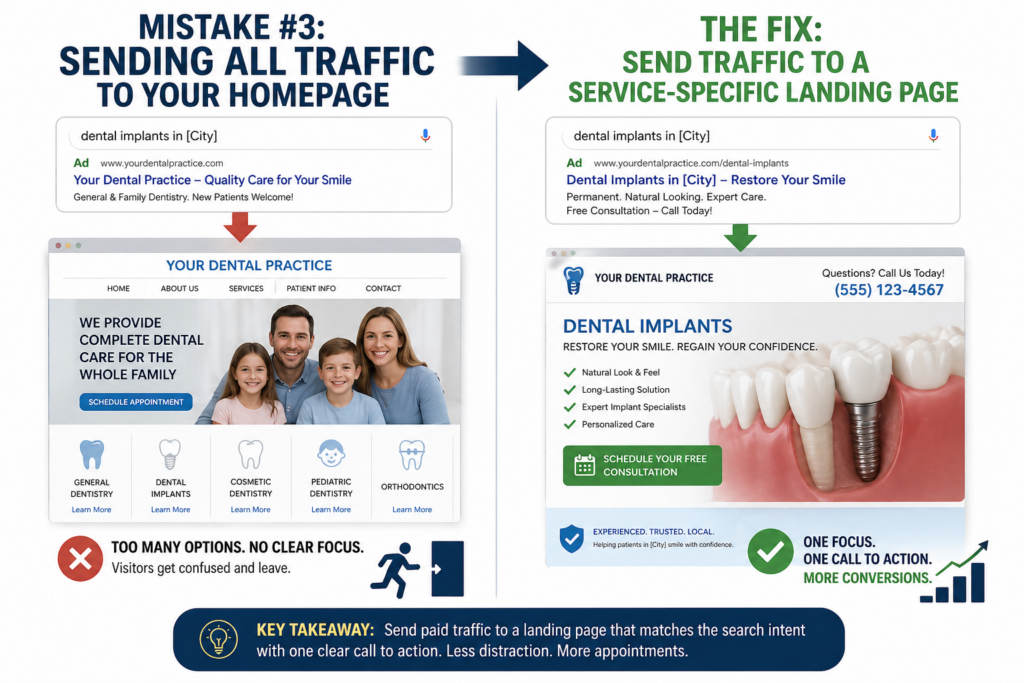
A patient searches “dental implants in [City]” and clicks your ad. They land on your homepage, a general page about your practice with links to everything from teeth cleanings to pediatric dentistry. They cannot find what they came for, and they leave.
Homepages serve everyone and convert no one. Sending paid traffic to a generic homepage is one of the most common, and costly, dental PPC mistakes in the industry.
The Fix
Create dedicated, service-specific landing pages for each campaign. A dental implant ad goes to a dental implants page. An emergency dentistry ad goes to an emergency care page. Each landing page should have one clear call to action, typically a phone number or booking form, and nothing else to distract the visitor.
Mistake #4: Ignoring Mobile Optimization
The majority of dental patients search for services on their smartphones. If your landing page takes more than three seconds to load, requires pinching and zooming to navigate, or does not have a clickable phone number front and center, you are losing leads before they even read your headline.
Mobile users are often searching in the moment, they have a toothache or need an emergency appointment. A slow, poorly formatted page sends them straight to a competitor.
The Fix
Test your landing pages on mobile before launching any dental PPC campaign. Aim for load times under three seconds, large tap-friendly buttons, and a click-to-call phone number visible without scrolling. Tools like Google PageSpeed Insights can help you identify and fix performance issues quickly.
Mistake #5: The “Set It and Forget It” Fallacy
Google Ads is not a slow cooker. You cannot configure a campaign in January and expect it to run optimally through December. Search behavior changes, local competition shifts, and Google’s algorithm updates constantly affect ad performance.
Dental practices that launch campaigns and walk away often end up overpaying for clicks, bidding on irrelevant terms, and running ads with outdated messaging, all without realizing it.
The Fix
Treat dental PPC as an ongoing process, not a one-time task. Review your Search Terms Report weekly, adjust bids based on performance data, and conduct a full campaign audit at least once per quarter. Regular monitoring turns average campaigns into high-performing ones.
Mistake #6: Flying Blind Without Conversion Tracking
If you do not know which keywords are generating patient appointments, and which are generating empty clicks, you are essentially guessing with your budget. Running dental PPC without conversion tracking is like investing in the stock market with your eyes closed.
Many practices track website visits but never set up tracking for form submissions or phone calls. This means they have no idea whether their high-spend keywords are producing high-value implant cases or low-value inquiries that never book.
The Fix
Implement full conversion tracking before spending another dollar on dental PPC. Set up Google Ads conversion tracking for both form fills and phone calls. For deeper insight, consider a call tracking tool that records which keyword triggered each call, this data lets you double down on what works and cut what does not.
Mistake #7: Bidding on Low-Intent Keywords
Bidding on broad terms like “dentist,” “teeth,” or “dental care” attracts users at the very top of the funnel, people who may be casually researching, not ready to book. These keywords are expensive, highly competitive, and have notoriously low conversion rates.
High-traffic keywords feel powerful, but if they attract window shoppers instead of ready-to-book patients, they drain your budget with little to show for it. This is especially damaging for smaller practices competing against large dental groups or corporate chains.
The Fix
Shift your dental PPC focus toward high-intent, long-tail keywords. Phrases like “emergency root canal near me,” “best dentist for dental implants in [City],” or “same-day tooth extraction [City]” attract people who are ready to act. They may have lower search volume, but they convert at a significantly higher rate, and at a lower cost per acquisition.
Bonus: Combine Dental PPC With Strong SEO for Maximum ROI
Dental PPC and dental website SEO are not competing strategies, they work best together. While PPC delivers immediate visibility, SEO builds long-term organic authority that reduces your reliance on paid traffic over time. Practices that invest in both typically see the lowest cost per new patient acquisition.
Use PPC data, specifically your highest-converting keywords, to inform your SEO content strategy. If “dental implants [City]” drives your best ROI in paid search, it should also be a priority page on your website.
Final Thoughts: Make Every Dental PPC Dollar Count
Dental PPC is one of the fastest ways to grow your practice, but only when it is managed strategically. The seven mistakes outlined above are costing dental practices thousands of dollars in wasted ad spend every month. The good news is that every single one of them is fixable.
Start by auditing your current campaigns against this list. Look at your geo-targeting settings, check whether you have dedicated landing pages, review your negative keyword list, and confirm that conversion tracking is live. Even fixing one or two of these issues can meaningfully improve your results.
If you are ready to stop wasting your budget and start attracting high-value patients consistently, consider working with a dental marketing specialist who understands both PPC strategy and dental website SEO. The right expertise can turn an underperforming campaign into your practice’s most reliable growth engine.