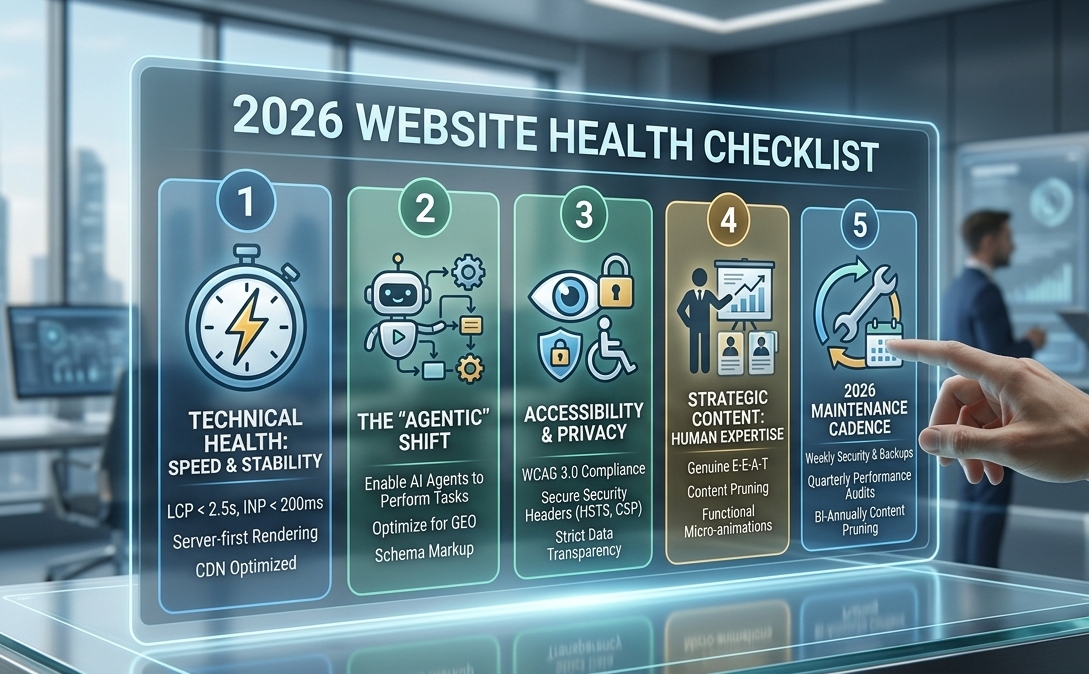
In 2026, a website is no longer just a digital business card. It has evolved into an intelligent, autonomous ecosystem that must work harder than ever.
If your site is slow, inaccessible, or unable to communicate with AI agents, you aren’t just losing visitors; you are becoming invisible. To stay competitive, you need to shift from a static “brochure” to a resilient, high-performance machine. This checklist will guide you through the five pillars of a future-proof digital presence, ensuring your web maintenance strategy is ready for the demands of modern users and search engines.
1. Technical Health: Speed and Stability
The technical foundation of your website determines whether users stay or leave within seconds. By 2026, patience is zero. Google’s Core Web Vitals remain the gold standard, but the targets are stricter.
To pass the test, your site must feel instantaneous. Aim for a Largest Contentful Paint (LCP) of under 2.5 seconds and an Interaction to Next Paint (INP) below 200 milliseconds. If your buttons lag, users perceive your brand as broken.
Furthermore, infrastructure matters. Utilizing a global CDN and next-gen formats like WebP or AVIF is standard practice. However, the cutting edge involves “Server-first” rendering (like React Server Components) to offload heavy JavaScript processing from the user’s device to the cloud.

2. The “Agentic” Shift: Beyond Chatbots
The biggest shift in 2026 is the rise of “Agentic AI.” AI agents (like Google’s Project Mariner or custom shopping bots) now browse the web for users. They don’t just read pages; they perform tasks.
Is your website ready for non-human eyes?
- Optimize for GEO (Generative Engine Optimization): Structure your content with clear, hierarchical headers and bullet points. AI agents pull answers from your site to cite as sources.
- Enable Agentic Actions: Replace static contact forms with AI agents capable of booking appointments, checking inventory, or even negotiating refunds without human intervention.
- Technical Accessibility: Just like screen readers, AI agents need clean code. Use schema markup extensively to define exactly what your products and services are.
3. Accessibility & Privacy: Non-Negotiable Standards
Accessibility is no longer just an ethical bonus; it is a legal requirement. With the introduction of WCAG 3.0 guidelines, the focus shifts from “checking technical boxes” to outcome-based usability.
WCAG 3.0 emphasizes that users with disabilities must be able to complete tasks successfully. This means ensuring color contrast ratios hit 4.5:1 and touch targets (buttons) are at least 48px for mobile users.
Simultaneously, privacy is paramount. With the death of third-party cookies, you must enforce strict security headers (HSTS, CSP) and ensure HIPAA-compliant hosting if you operate in healthcare. Transparency in data collection builds the trust required to convert a casual visitor into a customer.
4. Strategic Content: Human Expertise Wins
As AI-generated content floods the internet, bland articles are losing value. Search engines and users are now starving for genuine E-E-A-T (Experience, Expertise, Authoritativeness, Trustworthiness).
To stand out, your web maintenance routine must include content pruning.
- Remove “Thin” Content: If a page doesn’t serve a distinct purpose, delete or merge it.
- Showcase Humans: Include detailed author bios, real-world case studies, and custom photography. Generic stock photos signal low trust.
- Functional Motion: Use subtle micro-animations (progress bars, button states) to guide users through workflows without overwhelming them.
5. The 2026 Web Maintenance Checklist
A future-proof site is a living asset. You cannot “set and forget” it. You need a recurring schedule of maintenance to prevent technical decay.
Here is your essential 2026 web maintenance cadence:
- Weekly: Security & Backups
Run malware scans and verify your automated backup system works. In 2026, recovery speed is a competitive advantage. - Quarterly: Performance Audits
Use tools like Google PageSpeed Insights to check for “regressions”, updates that accidentally slowed you down. Fix broken links and 404 errors immediately, as they erode crawl budgets. - Bi-Annually: Content Pruning & Updates
Review your analytics for pages with high bounce rates. Update statistics, refresh outdated information, and ensure your “About” page reflects the current year and team. - Mobile-First Parity Check
Ensure the mobile version of your site contains all the features of the desktop version. Hiding content on mobile is a cardinal sin in 2026.
Conclusion: Start Your Health Check Today
The digital landscape of 2026 belongs to the resilient. Websites that combine lightning-fast infrastructure, agentic AI capabilities, and strict privacy standards will dominate search rankings and win customer trust.
Don’t wait for your traffic to drop before you act.