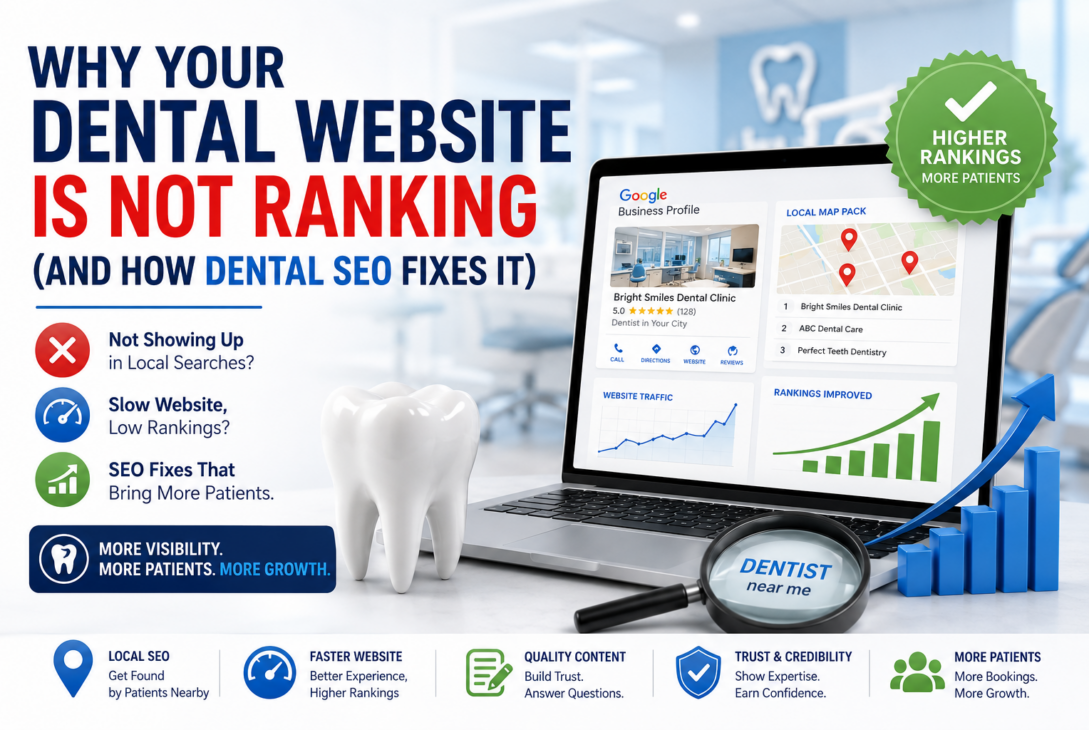
You built a beautiful dental website. You have great patient reviews, a full list of services, and a team that genuinely cares. Yet when a local patient searches for a dentist in your area, your practice is nowhere to be found. Sound familiar?
The problem is not your service. It is your dental SEO.
Search engine optimization for dental practices is a precise, multi-layered strategy. It ensures Google can find, trust, and recommend your website to patients nearby. Without it, even the most well-designed site remains invisible online. In this article, we will break down exactly why your dental website is not ranking and walk through how a proper dental SEO strategy can fix each issue.
Why Your Dental Website Is Not Ranking?
Most dental websites fail to rank for one or more of three core reasons: weak local trust signals, technical problems, and thin content. Here is a closer look at each.
1. Weak Local Search Signals
Neglected Google Business Profile
Your Google Business Profile (GBP) is often the first thing patients see in search results. If it is incomplete, unverified, or missing key details like your hours, services, and photos, Google will not feature you in the local Map Pack, which is the block of three businesses displayed above regular search results.
The Map Pack captures an enormous share of local clicks. Not appearing there is a significant missed opportunity for every dental practice.
Inconsistent NAP Information
NAP stands for Name, Address, and Phone number. If this information varies across your website, Google Business Profile, Yelp, Healthgrades, and other directories, search engines lose confidence in your listing.
Even minor differences, such as writing “St” in one place and “Street” in another, can hurt your local rankings. Consistency is everything in local dental SEO.
Missing Location-Specific Keywords
If your website never mentions the city or neighborhood you serve, Google cannot confidently match your site to local searches. Phrases like “dentist in Lahore” or “dental implants in DHA” are what connect your practice to the patients searching nearby.
2. Poor Technical Performance
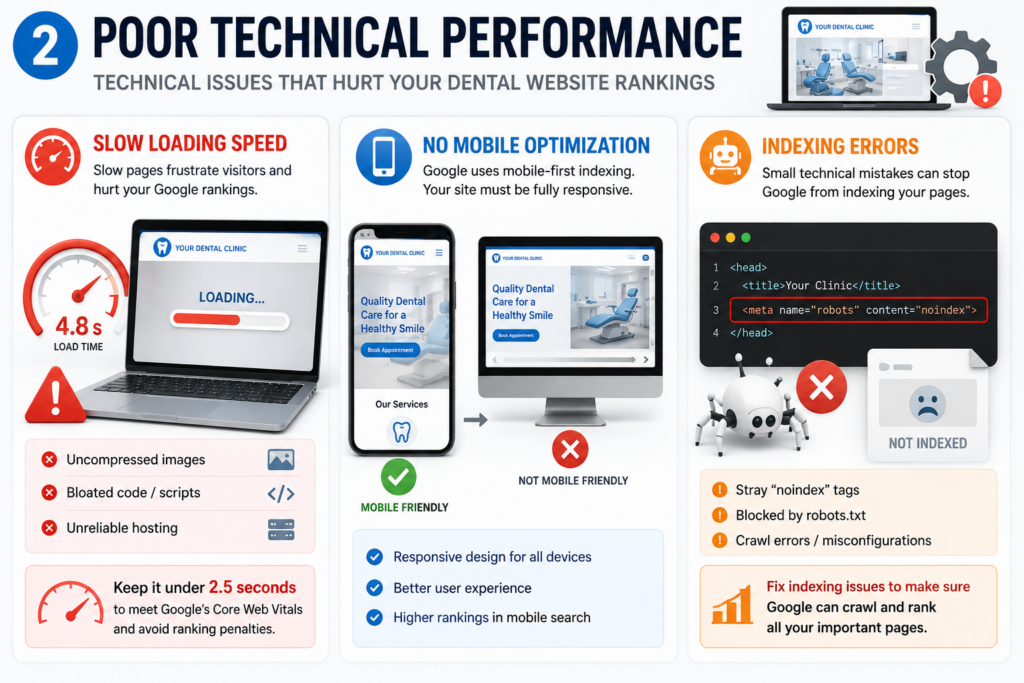
Slow Loading Speed
Google directly factors page speed into its ranking decisions. Dental websites with uncompressed images, bloated code, or unreliable hosting frequently load too slowly, causing visitors to leave before the page even appears. This raises your bounce rate and signals to Google that your site offers a poor experience.
According to Google’s own Core Web Vitals standards, pages should load key content in under 2.5 seconds to avoid ranking penalties.
No Mobile Optimization
The majority of dental searches happen on smartphones. Google now uses mobile-first indexing, which means it evaluates the mobile version of your site as the primary version. A site that is not fully responsive will struggle to rank, no matter how good it looks on a desktop.
Indexing Errors
Sometimes a simple misconfiguration, such as a stray “noindex” tag in your website’s code, can prevent Google from crawling your pages entirely. This type of silent technical error is surprisingly common and often goes undetected for months, costing your practice significant visibility.
3. Thin or Irrelevant Content
Generic Service Pages
If your “Invisalign” page says nothing more than “We offer Invisalign for straighter teeth,” it will not rank. Google evaluates whether a page genuinely answers a patient’s questions about that treatment. You need to cover the procedure, costs, recovery, eligibility, and FAQs to satisfy both users and search engines.
Missing Author Expertise
In healthcare, Google applies stricter quality standards known as E-E-A-T: Experience, Expertise, Authoritativeness, and Trustworthiness. Dental websites that do not clearly show which licensed professional authored or reviewed the content tend to rank lower because they cannot demonstrate medical credibility.
How Dental SEO Fixes It
A well-executed dental SEO strategy directly addresses every issue above. Here is how each problem gets resolved.
1. Mastering Local SEO
Fully Optimize Your Google Business Profile
Claim and verify your GBP if you have not already. Then fill in every field: business categories, service areas, operating hours, accepted insurance, and a detailed description using your city name and key services. Add real photos of your clinic, team, and treatment rooms.
Also actively encourage patients to leave Google reviews after appointments. Reviews are one of the strongest local ranking signals in dental SEO.
Standardize Your Practice Information
Conduct a full audit of every online directory where your practice appears. Tools like BrightLocal or Semrush’s Listing Management can help you identify and correct any inconsistencies in your NAP data across 50 or more platforms.
Build Location-Specific Landing Pages
Create dedicated pages targeting specific areas you serve, such as “Teeth Whitening in [Your City]” or “Emergency Dentist in [Neighborhood].” These pages should include embedded Google Maps, local landmarks, and area-specific language to strengthen your geographic relevance.
2. Fixing Technical Issues
Improve Site Speed
Start by compressing all images into modern formats like WebP. Remove unused plugins and scripts that slow down page load times. Use a reliable hosting provider and consider a content delivery network (CDN) to serve pages faster to local visitors.
Tools like Google PageSpeed Insights and GTmetrix can pinpoint exactly what is slowing your site down so your developer can fix it efficiently.
Apply Local Schema Markup
Schema markup is structured code that tells search engines and AI tools exactly what your practice offers. Adding LocalBusiness and Dentist schema to your website helps Google display your name, address, hours, and services directly in search results, improving both visibility and click-through rates.
Submit an XML Sitemap
Submit your sitemap through Google Search Console so every important page on your site gets crawled and indexed. Also use Search Console to check for any noindex errors, crawl blocks, or manual penalties that could be suppressing your rankings.
3. Elevating Content Quality
Write In-Depth Treatment Pages
For every major service, write a comprehensive page that goes beyond a basic description. Include information about the procedure, typical costs, recovery time, candidacy requirements, before-and-after expectations, and a detailed FAQ section. Naturally incorporate long-tail keywords like “affordable dental implants in [City]” or “Invisalign for adults near me.”
Add Clear Author and Credential Information
Every treatment page should clearly credit the dentist who authored or reviewed it, along with their qualifications and years of experience. This satisfies Google’s E-E-A-T requirements and builds trust with patients who are deciding whether to book an appointment.
Incorporate Patient Reviews Into Your Pages
Beyond your GBP, embed genuine patient testimonials on your treatment pages and homepage. Social proof strengthens both user trust and search engine confidence in your practice’s reputation.
Quick Reference: Common Issues and Their Dental SEO Fixes
| Issue | Root Cause | Dental SEO Solution |
| Not visible on Maps | Incomplete Google Business Profile | Complete GBP with categories, photos, and review outreach |
| Low mobile rankings | Slow speed and non-responsive design | Compress images to WebP and implement responsive design |
| No keyword visibility | Generic or thin content | Create in-depth, location-specific service pages |
| Missing from local searches | Inconsistent NAP data | Audit and standardize listings across 50+ directories |
| Low trust signals | No author credentials | Add licensed dentist bios and E-E-A-T-compliant content |
Conclusion: Your Rankings Are Not Fixed — They Are Built
A dental website that is not ranking is not a lost cause. It is simply a website that has not yet received the structured, technical, and content investment it needs to perform.
Dental SEO is not a one-time fix. It is an ongoing process of optimizing your local presence, improving technical performance, and consistently publishing content that genuinely serves your patients. Each improvement compounds over time, and the practices that invest early build a competitive advantage that is very difficult to close later.
If your practice is currently invisible in local search results, start with a free audit of your Google Business Profile and run your site through Google PageSpeed Insights. These two steps alone will reveal the most pressing gaps and give you a clear starting point.
The patients searching for a dentist in your area right now are going to someone. Dental SEO makes sure that someone is you.