
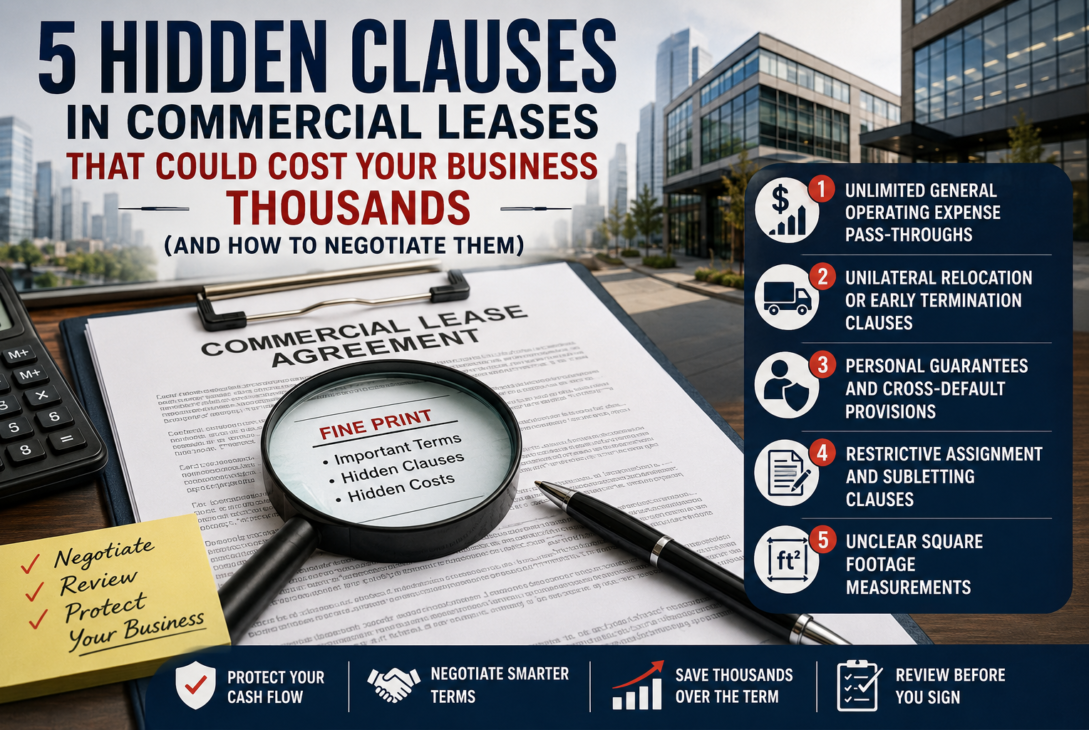
A commercial lease is one of the most significant business expenses an owner will incur. Most tenants are concerned with the monthly rent, the length of the lease, and a security deposit, but the most expensive surprises lurk in the fine print.
A commercial lease is more than just a typical contract; it is a legally enforceable agreement with clauses that can drive up your operating expenses in the future. Many of these provisions are negotiable, yet business owners rarely take time to review them until surprise bills start coming months or even years later.
Recognizing these clauses before signing can safeguard your cash flow, enhance your negotiating power, and even save your business thousands of dollars over the term of the lease.
Unlimited General Operating Expense Pass-Throughs
Operating Expense Pass-Throughs are one of the most common and overlooked lease provisions.
Often, commercial leases require tenants to pay their share of building costs, known as:
- Property maintenance
- Building insurance
- Landscaping
- Cleaning services
- Property management fees
- Security
- Property taxes
The problem is that there are no constraints on how much these costs can grow each year.
Left unchecked, however, your occupancy expenses could shoot up to be far beyond your base rent agreed at the start of your lease.
How to negotiate this clause
To address this, request explicit exclusions that will not allow the landlord to shift costs for items like:
- Structural building repairs
- Capital improvements
- Environmental remediation
- Costs benefiting only other tenants
It’s also wise to request:
- Controllable operating expenses capped at 3–5% per annum
- Annual expense statement audit rights
- Detailed breakdowns of all charges
These protections ensure more transparency and offer assurance that costs will not increase unexpectedly.
Unilateral relocation or early termination clauses
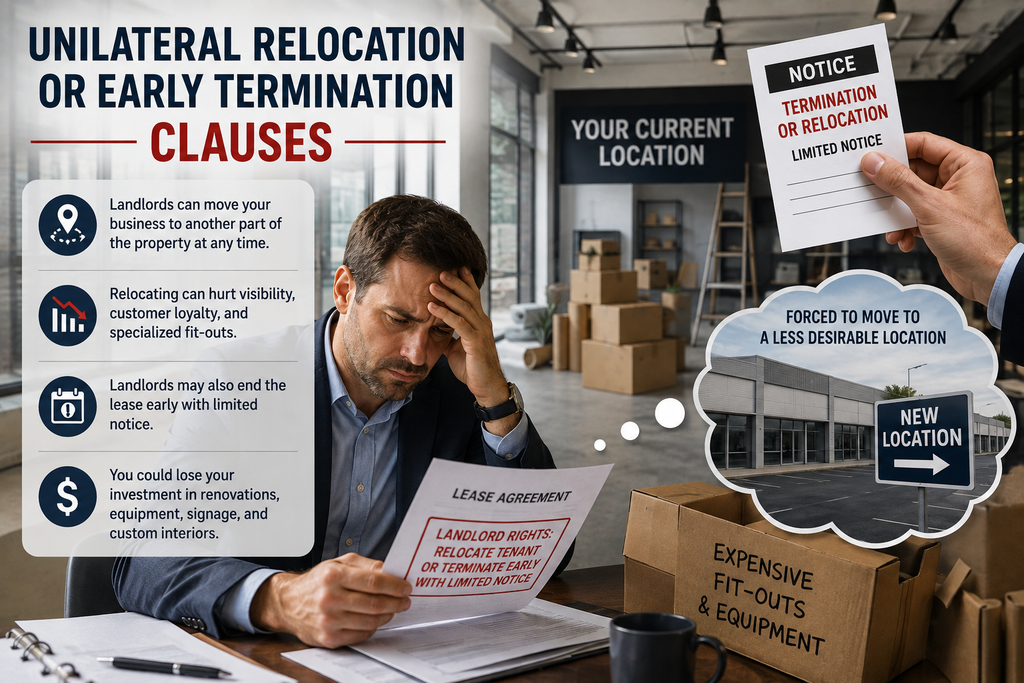
Certain leases mean that landlords can move your business from one part of the property to another whenever they wish.
Although it might seem innocuous, relocating can cripple businesses—particularly those that rely on visibility to customers, customer loyalty, or specialized fit-outs.
Even more worrisome are clauses giving landlords the right to end the lease early, with only a limited notice period.
It can be very expensive if you’ve spent a lot of money on renovation, new equipment, signage, or custom interior, but then you are forced to move.
How to negotiate this clause
PRAY to have relocation rights abandoned in full белым-arras.
If it can not be removed, negotiate for protections including:
- Written notice of six to twelve months
- Full reimbursement of relocation costs
- Replacement premises of comparable or improved standard
- Termination right if you can’t get the alternative space
Such measures ensure that, should relocation become imperative, operational disruption is minimized.
Personal Guarantees and Cross-Default Provisions
Most landlords require that business owners guarantee their lease obligations personally.
This is standard with new businesses, but a full personal guarantee means your personal assets could be at stake until the business can no longer pay its way out of its lease.
Others have cross-default clauses with certain agreements as well.
These provisions say that defaulting on any other lease with the same landlord might put your commercial lease in default automatically even if you have never been late on a rent payment.
This creates unnecessary financial exposure.
How to negotiate this clause
Instead of taking on an unlimited liability, you could be requesting:
- A limited personal guarantee
- Rolling guarantee paid over several years of successful payments
- A “good guy” clause that expires when you take back possession of the property
Also eliminate any cross-default language so that each agreement is treated independently.
Restrictive Assignment and Subletting Clauses
Business needs change.
Eventually, you might move, grow, consolidate, shrink, or sell your business before your lease is up.
Unfortunately, some commercial leases make it really hard to assign your premises or sublease.
Some agreements even allow landlords to refuse suitable replacement tenants without good reason.
While others require that tenants submit any profit from the subleasing.
Such restrictions can result in businesses having to pay rent on unused premises.
How to negotiate this clause
Make sure the lease contains the following clause, which states landlord approval:
- Cannot be unreasonably withheld
- Should be supplied promptly
- Includes clear approval criteria
If market rental rates increase, then negotiate the right to keep all or part of any legitimate profit made by the sublease rather than giving it to the landlord.
More flexibility today may turn out to be gold in the future.
Unclear Square Footage Measurements
Most tenants think they are only paying for the area they physically occupy.
Commercial leases, on the other hand, typically measure rent based upon “rentable” square footage, as opposed to usable space.
You could be unknowingly renting far more space than what you utilize without a recognized measurement standard.
A multi-year lease means even a tiny mismatch gets expensive.
How to negotiate this clause
Be sure that rentable area is measured to an accepted industry standard.
Add a reconciliation clause that updates rent levels if an independent measurement shows the actual rentable area to be other than as calculated in the lease.
This guarantees that you are only paying for the area that you are actually leasing.
Reasons why you create more opportunities when you negotiate early
Timing can have a huge impact on lease negotiations.
As commercial property markets develop, so too does the landlord flexibility, affected by demand and levels of vacant space.
Landlords are likely to offer better terms to businesses that approach them nine to twelve months before a lease expires rather than leaving things until the last three months before expiry.
Early conversations help build the case for the negotiation:
- Better rental terms
- Improvement allowances
- Flexible renewal options
- Reduced operating costs
- More favorable lease conditions
Procrastination usually confines you to the weakest hole.
A Commercial Lease Review Checklist
Before signing a commercial lease, you need to ensure it has:
- Clearly defined operating expense exclusions
- Annual caps on controllable CAM growth
- Audit rights for operating expenses
- No unrestricted landlord relocation rights
- Fair termination provisions
- Limited personal guarantees
- Removal of unnecessary cross-default clauses
- Reasonable assignment and subletting rights
- Industry-standard space measurements
- Adjustment of rent due to measurement discrepancies
Going through these items with a fine-tooth comb will save you from an unexpected expense in the future.
Frequently Asked Questions
Are commercial lease clauses negotiable?
Yes. Commercial leases are one of the most negotiable types of agreements, unlike many residential agreements. Additionally, operating expenses, guarantees, renewal options, and assignment rights are often subject to negotiation before signing.
What is a CAM charge?
Common Area Maintenance (CAM) charges are shared expenses billed to tenants for maintaining common areas and for building operations—these cover cleaning, landscaping, security, insurance, and property management, etc.
What is wrong with providing a personal guarantee?
A personal guarantee places you personally on the hook for lease obligations if your business is unable to fulfill the lease terms. As a result, and depending on how you word it, your personal assets may be on the table after the business stops trading.
Do I need a commercial lease review before signing?
Absolutely. Getting a legal or commercial property professional to review the agreement will help uncover any hidden risks, clarify any complex clauses, and improve your negotiating leverage ahead of signing a long-term contract.
How soon can I negotiate a lease renewal?
Typically, starting those conversations nine to twelve months out from the expiration of your lease will yield the most flexibility. Costs you incur are usually lower if you find your premises early, and you will have more room to negotiate terms that are favorable to you.
Defend Your Business Before You Sign
Finances: Always Choose a Commercial Lease that Benefits Your Business, Not One that Hits You with Unforeseen Surprises. They help you keep long-term costs in check and avoid disputes later by knowing what to look out for, what to ask, and with what provisions to negotiate before signing.
Every sentence might have an impact on your bottom line. It ultimately helps you understand the importance of reviewing the agreement, getting professional advice where necessary, and negotiating on an informed basis to safeguard your business for years to come.














[…] Commercial leases will usually also include various dates, such as the start of possession, the end of construction, the store opening, and the start of rent. […]