Patients no longer “look for a dentist.” They search, compare, read reviews, and book, often before your front desk even opens. If your practice isn’t visible, credible, and easy to book with at every one of those steps, a competitor down the street will earn the appointment instead.
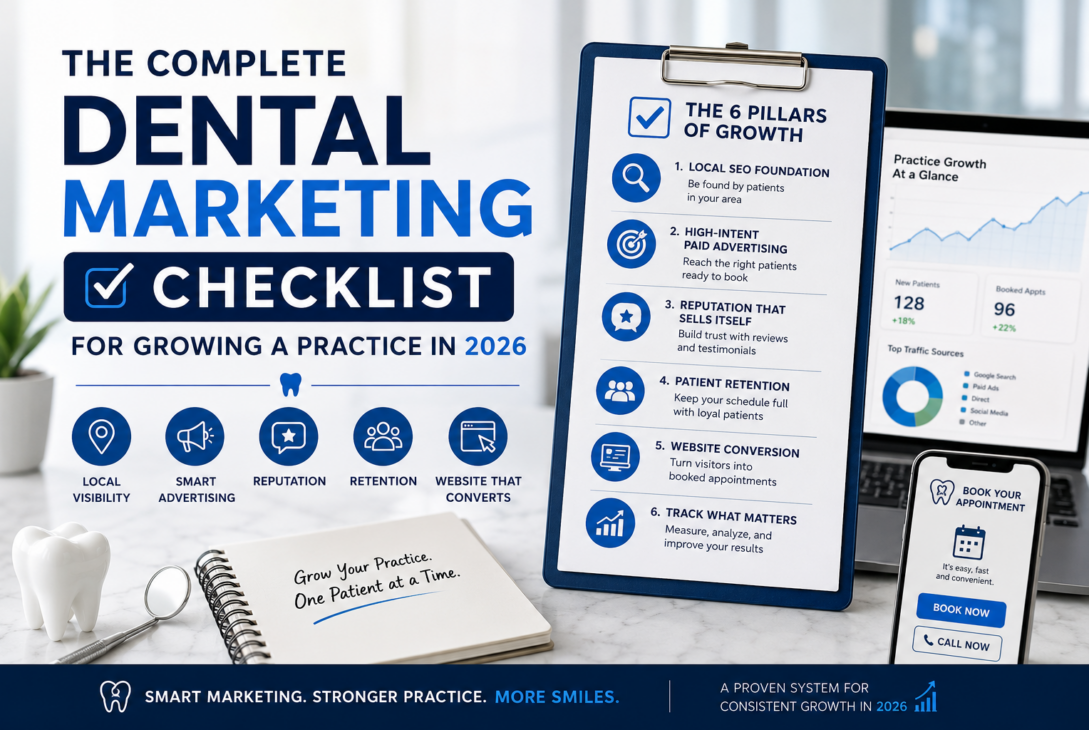
That’s why marketing for dentists in 2026 is less about a single tactic and more about a coordinated system: local visibility, smart advertising, reputation, retention, and a website that converts. This checklist walks through each pillar so you can grow your practice with a plan instead of guesswork.
Why Dental Marketing Has Changed
Patients now expect the same convenience from a dental office that they get from any other consumer brand — 24/7 online booking, instant text confirmations, and answers available with a quick search.
AI-powered search tools have also changed how people find care. Search engines and chat assistants increasingly favor practices with strong local signals and clear, easy-to-parse content over those relying on outdated directory listings.
Growing a practice today means building demand across every channel at once, then tracking which ones actually bring in booked patients.
1. Strengthen Your Local SEO Foundation
Local search is still the highest-return channel available to most practices, because nearby patients are actively looking for care right now.
Claim and Optimize Your Google Business Profile
- Use precise, exact-match categories, such as General Dentist or Cosmetic Dentist, rather than broad labels.
- Keep your profile active with weekly photos of your office, team, and patient experience.
- Verify your listing through Google’s official Business Profile help center to avoid suspension issues.
Keep Your NAP Consistent
- Your Name, Address, and Phone number should match exactly across your website, directories, and social profiles.
- Inconsistent listings confuse both patients and search algorithms, quietly costing you rankings.
Build Local Landing Pages
- If you serve several neighborhoods, create dedicated pages for each service area with parking notes and nearby landmarks.
- This helps both patients and AI-driven search tools understand exactly who you serve.
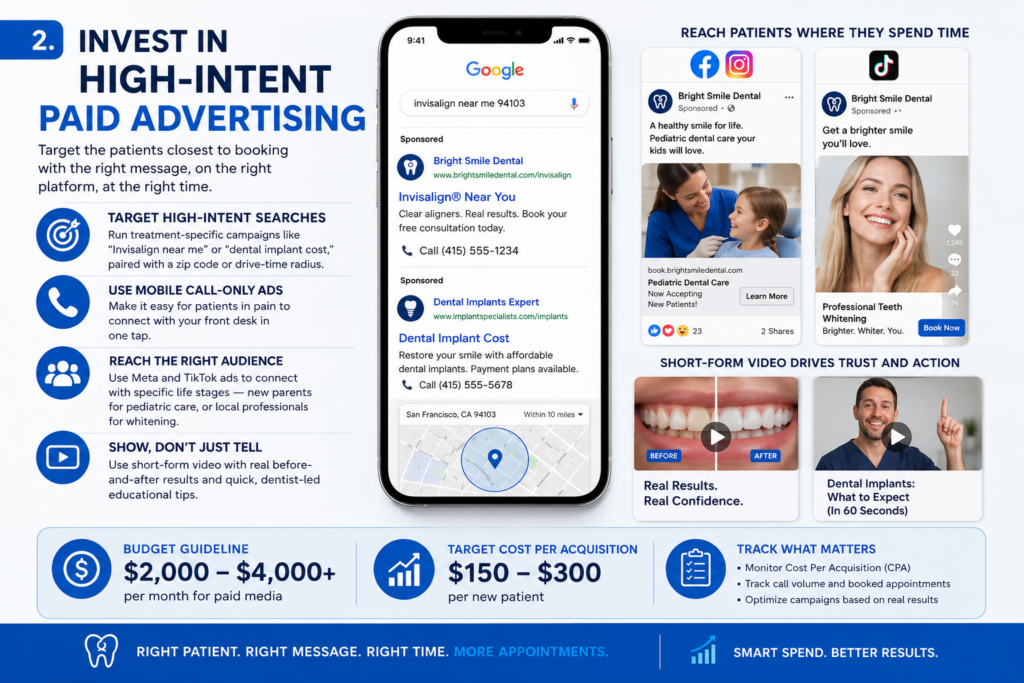
2. Invest in High-Intent Paid Advertising
Broad “best dentist near me” campaigns are expensive and attract low-intent clicks. A sharper approach targets the patients closest to booking.
- Run treatment-specific campaigns for searches like “Invisalign near me” or “dental implant cost,” paired with a zip code or drive-time radius.
- Set up mobile call-only ads so patients in pain can reach your front desk with one tap.
- Use Meta and TikTok ads to reach specific life stages — new parents for pediatric care, or local professionals for whitening.
- Add short-form video showing real before-and-after results and quick, dentist-led educational tips.
Most practices budget $2,000 to $4,000 or more per month for paid media, with a target Cost Per Acquisition between $150 and $300. Track this closely so spend keeps pace with results.
3. Build a Reputation That Sells Itself
Reviews are often the deciding factor between two practices with similar services and pricing.
Automate review requests through SMS immediately after each visit — text messages see far higher open rates than email, making them the faster path to new reviews.
Respond to every review, positive or negative, within 24 to 48 hours. Thoughtful, professional replies to criticism often build more trust than five-star reviews alone.
Feature a mix of written testimonials and short video clips on your site, organized by treatment, so prospective patients can find stories relevant to their own needs.
4. Keep the Patients You Already Have
Acquiring a new patient costs far more than keeping an existing one, which makes retention one of the most overlooked growth levers in dentistry.
- Automate recall reminders and appointment confirmations through SMS and email.
- Build drip sequences that gently follow up with patients who have an open treatment plan.
- Send “we miss you” campaigns to patients who’ve drifted past their six-month recall window.
- Ask happy patients for referrals directly, and make sharing simple with digital referral cards.
5. Turn Your Website Into a Conversion Machine
Your website is where interest turns into a booked appointment — or where it’s lost.
- Design mobile-first, since the majority of dental searches happen on a phone; buttons for “Call Now” and “Book Now” should be impossible to miss.
- Write FAQs and blog content conversationally so AI answer engines like ChatGPT and Gemini can accurately reference your practice.
- Offer digital-first payment options, including text-to-pay and clear financing details, directly on service pages.
6. Track the Numbers That Actually Matter
A checklist only works if you measure the results behind it. Review your data monthly instead of setting campaigns and forgetting them.
- Calculate Cost Per Acquisition by dividing monthly ad spend by booked appointments.
- Use call tracking numbers on different marketing materials to see exactly which channel drives each call.
- Monitor your treatment plan acceptance rate — a healthy practice typically lands between 70% and 90%.
Helpful Resources
Verify and manage your listing directly through the Google Business Profile Help Center, and review clinical guidance from the American Dental Association when publishing patient-facing content.
For a deeper walkthrough of ranking locally, see our related guide, Local SEO for Dental Practices, and our companion piece on Patient Retention Strategies That Work.
Conclusion
Growing a dental practice in 2026 isn’t about chasing one trend — it’s about running local SEO, paid advertising, reputation, retention, and website conversion together as one system, then tracking what actually works.
Start with whichever pillar is weakest today, whether that’s an outdated Google Business Profile or a website that isn’t mobile-friendly, and build from there.
Ready to put this checklist into action? Reach out to our team for a free marketing audit and a clear, prioritized plan for growing your practice this year.