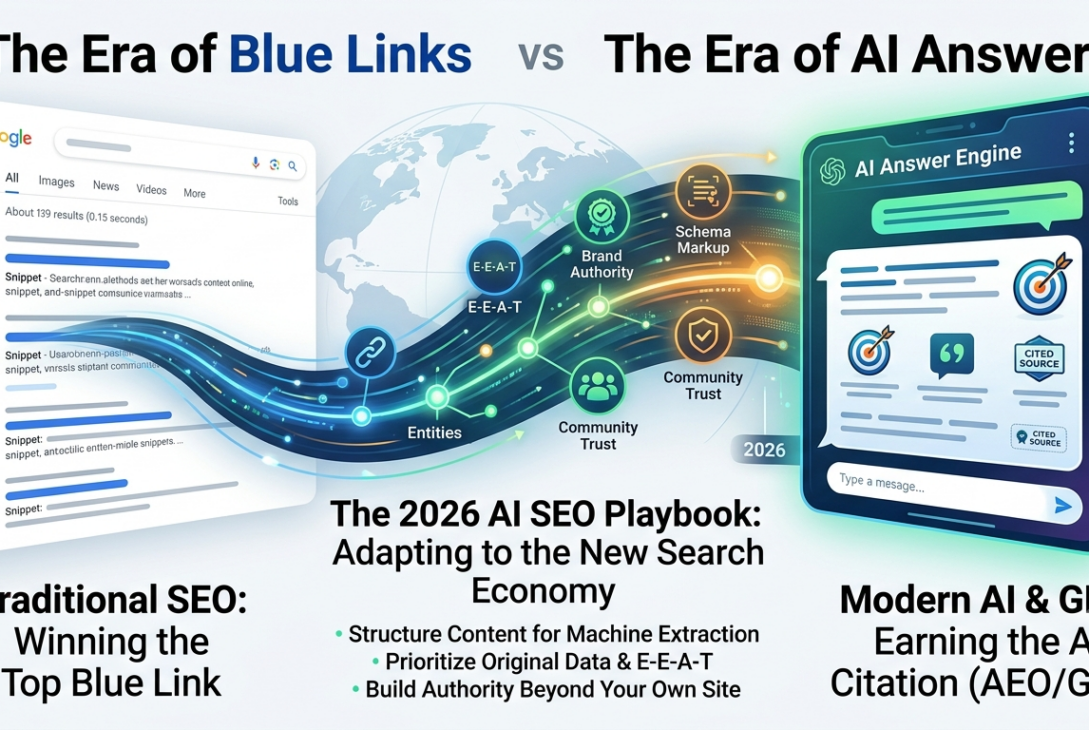
Search is no longer a race for the top blue link. In 2026, the real prize is being the answer AI platforms choose to cite. As Google’s AI-powered search features and standalone AI assistants increasingly answer questions directly, businesses that once optimized purely for rankings now have to earn a spot inside the response itself.
This shift has given rise to two new disciplines sitting alongside classic SEO: Answer Engine Optimization (AEO) and Generative Engine Optimization (GEO). Together, they describe how brands get found, trusted, and quoted by AI systems. Ignoring this shift risks a slow but steady loss of visibility, even for sites that still rank well in traditional search.
This article breaks down how AI search has changed the rules, and lays out a practical AI SEO playbook you can start applying today.
How AI Search Has Redefined the Rules of SEO
The way people search, and the way search engines respond, has fundamentally changed. Three shifts matter most.
Conversational, Longer Queries
People increasingly type and speak full questions rather than short keyword fragments. Instead of “dentist near me hours,” a user might ask, “Which dentist near me is open on Saturday and takes new patients?” Content written for fragmented keywords struggles to match this level of natural, conversational intent.
Synthesized Answers Instead of Link Lists
Rather than presenting ten blue links, AI-powered search results now weigh competing sources and generate a single synthesized answer. Your content can be the source behind that answer, or it can be invisible to it. There’s very little room in between.
Entity Authority Over Keyword Matching
AI systems increasingly reason in terms of entities: recognized brands, real people, and well-defined concepts. Repeating an exact-match keyword matters far less than being a source the system already recognizes as credible on that topic.
The 2026 AI SEO Playbook
Adapting to this new environment means layering AI-specific tactics on top of solid fundamentals. Here is where to focus.
1. Structure Content for Machine Extraction
AI systems reward content that is easy to lift into a summary. That means writing with extraction in mind, not just readability.
- Lead with the answer: put a direct, complete answer in the first two or three sentences of any page or section, before adding context.
- Use question-based subheadings (H2/H3) that mirror how real users phrase their queries.
- Break content into short paragraphs, scannable bullet lists, and clear tables wherever comparison or step-by-step data is involved.
- Add clean schema markup, especially FAQ and Product schema, so crawlers can parse structure without guesswork.
2. Prioritize Original Data and E-E-A-T
Generative AI can summarize generic knowledge instantly, which means generic content adds little value. Differentiation now comes from what a model cannot simply generate on its own.
- Publish original research, case studies, and real numbers that come from your own operations, not from paraphrasing competitors.
- Attach clear author bios with verifiable credentials and real experience to satisfy Google’s E-E-A-T (Experience, Expertise, Authoritativeness, Trustworthiness) standards.
3. Build Authority Beyond Your Own Website
AI systems cross-check a brand’s reputation across the web rather than trusting a single site in isolation.
- Pursue digital PR: mentions in industry podcasts, trade newsletters, and niche publications carry real weight.
- Monitor and encourage genuine discussion on high-trust community platforms, since AI models weigh community sentiment heavily.
- Keep a steady stream of detailed, specific reviews on Google Business Profile and relevant directories, since specificity (services, locations) helps verification.
4. Track the Metrics That Actually Matter Now
Classic traffic metrics no longer tell the full story. Fewer clicks can still mean more qualified, high-intent visitors.
- Use Search Console’s AI-related performance data and third-party visibility tools to track how often you’re cited in AI-generated answers.
- Regularly query consumer AI platforms yourself to see how they describe your business, and correct your content quickly if the summary is wrong or incomplete.
Traditional SEO vs. AI & GEO: A Side-by-Side View
The table below summarizes the operational shift businesses need to make.
| Metric / Objective | Traditional SEO Approach | Modern AI & GEO Approach |
| Primary goal | Rank at the top of classic blue-link results | Earn citations inside AI-generated answers |
| Interface style | A chronological list of website links | A synthesized, conversational summary |
| Core strategy | Keyword targeting and backlink volume | Extractable content and multi-surface trust |
| User interaction | Users click through to a website | Users read a summarized answer before ever clicking |
| Key KPIs | Page views, rankings, organic sessions | Citation frequency, assisted conversions, brand mentions |
Getting Started with AI SEO
None of this replaces core SEO fundamentals like technical health, page speed, or backlinks. It builds on them. The businesses that win in 2026 are the ones that treat AI platforms as a new, high-value audience of their own, one that reads content, checks facts across the web, and decides who gets quoted.
Start small: pick your highest-traffic page, rewrite the opening to directly answer its core question, add FAQ schema, and check how AI platforms summarize it. Then expand that process across your site.
If you’d like a tailored AI SEO roadmap for your specific business, industry, and audience, reach out, and we’ll map out the exact steps to get your brand cited, not just ranked.