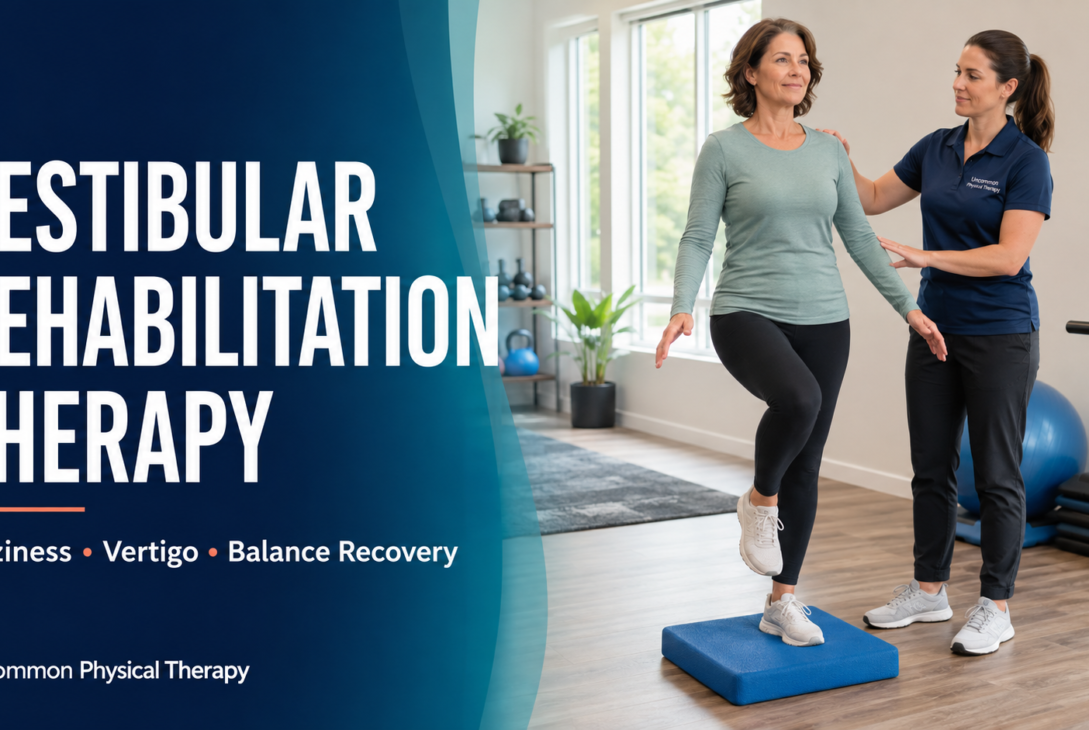
Dizziness, vertigo, and poor balance can make ordinary activities feel difficult or unsafe. Turning in bed, standing from a chair, walking through a busy store, driving, using stairs, or moving the head quickly may trigger uncomfortable symptoms.
Some people describe the room as spinning. Others feel lightheaded, unsteady, disoriented, or as though they are walking on an uneven surface.
These symptoms can have several causes. They may be related to the inner ear, nervous system, medication, blood pressure, vision, migraine, injury, or another medical condition.
Vestibular Rehabilitation Therapy is a form of physical therapy designed for selected people with dizziness, vertigo, gaze problems, and balance limitations.
Treatment begins with an assessment. The therapist then selects exercises or positioning techniques based on the patient’s symptoms, medical history, movement findings, and diagnosis.
What Is the Vestibular System?
The vestibular system includes parts of the inner ear and brain that help control balance, spatial awareness, and eye movement.
Structures in the inner ear sense:
- Head position
- Head movement
- Acceleration
- Changes in direction
- The body’s relationship with gravity
The brain combines this information with signals from the eyes, muscles, and joints.
When these systems work together, you can keep your vision stable while moving, adjust your posture, and walk without feeling disoriented.
When vestibular signals are damaged, delayed, or inconsistent, symptoms may include:
- Dizziness
- Vertigo
- Unsteadiness
- Nausea
- Motion sensitivity
- Blurred vision during movement
- Difficulty walking in the dark
- Trouble moving through crowded places
- Fear of falling
The National Institute on Deafness and Other Communication Disorders explains that balance disorders may involve the inner ear, brain, vision, medications, or other health conditions.
Are Dizziness and Vertigo the Same?
Dizziness is a broad term that people use to describe several different sensations.
A person may feel:
- Lightheaded
- Faint
- Unsteady
- Disconnected from the surroundings
- Pulled to one side
- As though the floor is moving
- Unable to focus while walking
Vertigo is a more specific feeling of spinning or movement when the person or surrounding environment is not actually moving.
Some people experience both dizziness and vertigo. Others have balance loss without any spinning sensation.
Describing the symptoms accurately helps the physical therapist or medical provider decide what testing may be appropriate.
What Is Vestibular Rehabilitation Therapy?
Vestibular rehabilitation is an exercise-based form of physical therapy.
It may use eye, head, balance, walking, and positioning activities to help the nervous system respond more effectively to movement and changes in position.
A personalized program may include:
- Canalith repositioning procedures
- Gaze-stabilization exercises
- Habituation exercises
- Balance training
- Walking activities
- Head-movement practice
- Coordination exercises
- Fall-risk reduction
- Home exercises
- Education about symptom management
The program should match the identified problem.
A patient with benign paroxysmal positional vertigo may need a repositioning procedure. A patient with vestibular weakness may need gaze-stabilization and balance exercises.
Using the same program for every dizzy patient would not be appropriate.
Who May Benefit From Vestibular Physical Therapy?
Vestibular Physical Therapy may be considered for people with symptoms or diagnoses such as:
- Benign paroxysmal positional vertigo
- Unilateral vestibular hypofunction
- Bilateral vestibular hypofunction
- Vestibular neuritis
- Labyrinthitis after the acute stage
- Persistent balance problems
- Motion sensitivity
- Gaze instability
- Post-concussion dizziness
- Vestibular migraine
- Chronic balance problems related to Ménière’s disease
- Age-related balance loss
- Dizziness after certain surgeries or illnesses
- Fear of falling after a vestibular episode
Physical therapy may not be appropriate for every cause of dizziness.
Some patients need assessment by a physician, neurologist, ear specialist, cardiologist, or another provider before beginning rehabilitation.
What Is BPPV?
Benign paroxysmal positional vertigo, commonly called BPPV, is a frequent cause of brief spinning sensations triggered by changes in head position.
Symptoms may occur when:
- Rolling over in bed
- Looking upward
- Bending forward
- Sitting up from bed
- Lying down
- Turning the head quickly
BPPV occurs when small calcium carbonate particles inside the inner ear move into a semicircular canal where they do not belong.
Head movement then causes those particles to shift, sending inaccurate motion signals to the brain.
The spinning sensation is often strong but brief. Some people continue feeling unsteady or mildly nauseated after the spinning stops.
How Is BPPV Assessed?
A trained provider may use positional tests to determine whether head movement produces a pattern that matches BPPV.
Testing may include:
- Dix-Hallpike test
- Supine roll test
- Observation of involuntary eye movement
- Review of symptom duration
- Comparison of right and left sides
The direction and timing of the eye movement can help the provider identify which inner-ear canal may be involved.
BPPV testing may briefly reproduce vertigo. The therapist should explain the process before beginning and provide support throughout the test.
What Is the Epley Maneuver?
The Epley Maneuver is a canalith repositioning procedure commonly used for certain cases of posterior-canal BPPV.
The provider guides the patient through a sequence of head and body positions. The goal is to move the displaced particles out of the affected semicircular canal.
The American Academy of Otolaryngology–Head and Neck Surgery recommends appropriate canalith repositioning procedures for posterior-canal BPPV.
The Epley maneuver does not treat every cause of dizziness. Different canals or conditions may require different procedures.
Patients should also tell the therapist about:
- Neck problems
- Back problems
- Recent surgery
- Vascular conditions
- Severe mobility limits
- Pregnancy
- Retinal problems
- Other medical restrictions
These factors may affect how positional testing or treatment is performed.
Should You Perform the Epley Maneuver at Home?
Online videos make the Epley maneuver appear simple, but self-treatment is not the right first step for every dizzy patient.
Before attempting it, the cause and affected side should be identified.
Performing the wrong procedure may:
- Fail to address the symptoms
- Make dizziness temporarily worse
- Move particles into another canal
- Place stress on the neck or back
- Delay assessment of another condition
A healthcare provider may teach an appropriate home procedure after determining that the symptoms match BPPV.
New, severe, persistent, or unusual dizziness should be medically evaluated instead of repeatedly treated with online exercises.
What Is Vestibular Hypofunction?
Vestibular hypofunction means that part of the balance system in one or both inner ears is not working normally.
Unilateral vestibular hypofunction affects one side. Bilateral vestibular hypofunction affects both sides.
Possible symptoms include:
- Blurred or bouncing vision during head movement
- Unsteadiness while walking
- Difficulty walking in the dark
- Trouble on uneven surfaces
- Dizziness during quick movements
- Motion sensitivity
- Poor balance when the feet are close together
- Difficulty turning while walking
A clinical practice guideline published through the American Physical Therapy Association supports vestibular physical therapy for people with peripheral vestibular hypofunction.
The exercises must be selected and progressed according to the patient’s condition and response.
Gaze-Stabilization Exercises
The vestibulo-ocular reflex helps keep vision steady while the head moves.
When this reflex is not functioning properly, a person may feel that words, objects, or surroundings blur or bounce during movement.
Gaze-stabilization exercises may involve:
- Looking at a fixed target
- Moving the head from side to side
- Moving the head up and down
- Changing movement speed
- Changing the background
- Practicing while sitting, standing, or walking
The goal is not to strengthen the eye muscles. It is to train coordination between head movement and visual focus.
The therapist should control the duration and speed carefully. Excessive practice can produce more symptoms without improving the response.
Habituation Exercises
Habituation exercises use repeated, controlled exposure to movements or visual situations that produce manageable symptoms.
These may be used when dizziness occurs during:
- Bending
- Turning
- Looking upward
- Moving between sitting and lying
- Walking through stores
- Watching moving screens
- Riding in a vehicle
- Being around busy visual patterns
The nervous system may gradually become less sensitive to the movement.
Habituation does not mean forcing the patient through severe dizziness. Exercises should create only the level of symptoms the therapist believes is safe and useful.
Balance and Walking Training
Vestibular disorders may reduce stability, especially when visual information is limited or the walking surface changes.
Balance training may include:
- Standing with the feet in different positions
- Standing on firm or soft surfaces
- Turning the head while standing
- Walking while moving the head
- Changing walking speed
- Stepping over objects
- Practicing turns
- Using stairs
- Walking in lower-light conditions
- Performing two tasks at once
The physical therapist may provide close support or use a stable surface to reduce fall risk.
Exercises should become more difficult only when the patient can complete the current level safely.
Physical Therapy for Motion Sensitivity
Busy visual environments can be difficult for people with vestibular problems.
Symptoms may occur in:
- Grocery stores
- Shopping centers
- Crowded rooms
- Movie theaters
- Heavy traffic
- Airports
- Escalators
- Places with patterned floors
- Computer-based work
A Dizziness Physical Therapy plan may gradually introduce head movement, visual motion, and functional tasks.
The goal is to help the patient return to daily environments without avoiding every activity that may trigger mild symptoms.
Vestibular Therapy After a Concussion
A concussion can affect balance, eye movement, neck function, concentration, and tolerance for motion.
Symptoms may include:
- Dizziness
- Headache
- Blurred vision
- Motion sensitivity
- Poor balance
- Difficulty reading
- Trouble focusing
- Neck pain
- Fatigue
Vestibular therapy may be one part of concussion care.
The treatment plan may include gaze activities, balance exercises, walking, neck assessment, controlled aerobic activity, and gradual return to work, school, or sport.
A concussion should be evaluated appropriately, especially when symptoms follow a recent head injury.
Vestibular Migraine and Physical Therapy
Vestibular migraine may cause dizziness, vertigo, imbalance, visual sensitivity, or motion intolerance. These symptoms may occur with or without a typical migraine headache.
Physical therapy does not replace medical migraine management.
However, selected patients may benefit from:
- Balance training
- Gaze exercises
- Motion-tolerance activities
- Neck assessment
- Postural exercise
- Gradual return to physical activity
- Education about symptom triggers
Treatment must be paced carefully because patients with migraine may be sensitive to light, sound, movement, or visual patterns.
Ménière’s Disease and Chronic Balance Problems
Ménière’s disease may cause episodes of vertigo, hearing changes, tinnitus, and pressure in the affected ear.
Vestibular therapy does not stop every Ménière’s attack.
The National Institute on Deafness and Other Communication Disorders notes that vestibular rehabilitation or physical therapy may be recommended for chronic balance problems.
Rehabilitation may address unsteadiness that remains between episodes. A patient experiencing an active or rapidly changing condition should coordinate care with the appropriate medical provider.
When Dizziness Requires Emergency Care
Not all dizziness comes from a benign inner-ear problem.
The Centers for Disease Control and Prevention identifies sudden dizziness, trouble walking, loss of balance, and poor coordination as possible stroke symptoms when they occur with other warning signs.
Call emergency services immediately when sudden dizziness or balance loss occurs with:
- Facial drooping
- Weakness or numbness on one side
- Trouble speaking
- Confusion
- Sudden vision changes
- Severe headache
- Loss of coordination
- Fainting
- Chest pain
- Difficulty breathing
- Inability to walk
- New double vision
A routine physical therapy appointment is not the correct first step for these symptoms.
Other reasons for prompt medical assessment include:
- A recent serious head injury
- Sudden hearing loss
- Repeated vomiting
- High fever
- New neurological symptoms
- Severe neck pain
- Symptoms that continue to worsen
- Dizziness after starting a new medication
What Happens During a Vestibular Evaluation?
A vestibular therapist begins by reviewing the patient’s symptoms, medical history, medications, falls, and functional limitations.
Questions may include:
- When did the symptoms begin?
- Do you feel spinning, lightheadedness, or imbalance?
- How long does each episode last?
- Which movements trigger symptoms?
- Do symptoms occur while lying down?
- Have you experienced hearing changes?
- Are headaches or migraines present?
- Have you fallen?
- Was there a recent illness or injury?
- Are you taking new medications?
- Which activities have you stopped?
The physical examination may assess:
- Eye movement
- Head-movement tolerance
- Positional vertigo
- Standing balance
- Walking
- Coordination
- Leg strength
- Neck movement
- Sensation
- Functional mobility
- Fall risk
The therapist may refer the patient to another provider when the findings do not appear appropriate for physical therapy.
Is Vestibular Therapy Uncomfortable?
Some vestibular tests and exercises may temporarily reproduce dizziness, nausea, or imbalance.
This does not mean that severe symptoms should be ignored.
The therapist should explain:
- Which symptoms may occur
- How strong they should be
- How long they may last
- When to stop
- When to contact a healthcare provider
Treatment should be challenging enough to produce a useful response without leaving the patient unable to function for the rest of the day.
Communication helps the therapist adjust the exercise level.
How Long Does Vestibular Rehabilitation Take?
There is no single timeline.
The length of care may depend on:
- Diagnosis
- Symptom duration
- Whether one or both ears are affected
- Fall history
- Migraine
- Neurological conditions
- Vision
- Strength
- Home-exercise participation
- Other medical conditions
- Response to treatment
Some cases of BPPV may respond to one or a small number of repositioning sessions.
Vestibular weakness, post-concussion symptoms, or long-term balance problems may require several weeks or longer.
Progress should be reviewed regularly. If symptoms do not change as expected, the diagnosis or treatment plan may need to be reconsidered.
Can Vestibular Exercises Be Completed at Home?
A home program is often part of vestibular rehabilitation.
It may include:
- Gaze-stabilization practice
- Balance exercises
- Walking tasks
- Controlled head movements
- Habituation activities
- Repositioning exercises when appropriate
The patient should understand:
- How often to practice
- How long each exercise should last
- What symptom level is acceptable
- What safety support is required
- When to stop
- When to contact the therapist
Balance exercises should not be performed alone in an unsafe area. A counter, wall, sturdy chair, or another person may be needed for support.
Reducing Fall Risk
Dizziness and poor balance may increase the risk of falling.
A therapist may discuss practical changes such as:
- Improving lighting
- Removing loose rugs
- Clearing walking paths
- Using railings
- Wearing supportive shoes
- Standing slowly
- Keeping frequently used items within easy reach
- Using an assistive device when recommended
- Avoiding unsafe balance exercises without support
The objective is to remain active while reducing avoidable risk.
Long periods of inactivity may lead to weakness, reduced confidence, and more difficulty returning to normal movement.
Choosing a Vestibular Therapist Near You
People searching for a Vestibular Therapist Near Me, Vertigo Physical Therapy, or Physical Therapy for Balance Problems should look beyond distance alone.
Consider whether the clinic:
- Evaluates different causes of dizziness
- Screens for symptoms requiring medical referral
- Performs appropriate positional testing
- Provides canalith repositioning when indicated
- Uses personalized gaze and balance exercises
- Reviews fall risk
- Explains the reason for each exercise
- Provides clear home instructions
- Measures progress
- Communicates with other healthcare providers
- Offers meaningful one-on-one treatment time
A therapist should not assume that every person with dizziness has BPPV.
Vestibular Rehabilitation in North Charlotte
Patients seeking Vestibular Rehabilitation North Charlotte can discuss their symptoms with Uncommon Physical Therapy.
The clinic lists rehabilitation for dizziness, vertigo, and balance disorders among its services. Care may include:
- Individualized assessment
- Positional testing
- Epley maneuver when appropriate
- Gaze-stabilization exercises
- Balance training
- Walking activities
- Motion-sensitivity exercises
- Fall-risk assessment
- Home-program instruction
Treatment should reflect the patient’s diagnosis, tolerance, daily activities, and goals.
One patient may want to roll over in bed without vertigo. Another may need to walk confidently through a store, drive comfortably, return to work, or reduce the fear of falling.
Vestibular Care at Uncommon Physical Therapy
Uncommon Physical Therapy provides outpatient physical therapy in Charlotte with meaningful one-on-one time between the patient and physical therapist.
The clinic focuses on:
- Listening to the patient’s concerns
- Individual treatment plans
- Clear explanations
- Active rehabilitation
- Progress reviews
- Honest expectations
- Patient participation
A complimentary 15-minute phone conversation with a licensed physical therapist is available for prospective patients who want to discuss their concerns before scheduling.
Results depend on the cause of the symptoms, medical history, duration, participation, and response to treatment.
Frequently Asked Questions
Vestibular rehabilitation is a form of physical therapy for selected people with dizziness, vertigo, gaze problems, and poor balance. Treatment may use repositioning procedures, eye and head exercises, balance training, and walking activities.
Physical therapy may help when vertigo is related to conditions such as BPPV or vestibular weakness. The cause should be assessed before treatment begins.
The Epley maneuver is used for certain cases of posterior-canal BPPV. It guides displaced inner-ear particles back toward an area where they are less likely to trigger vertigo.
Some people respond after one session, while others need repeat treatment or a different procedure. Persistent symptoms should be reassessed.
Testing and exercises may temporarily reproduce mild or moderate symptoms. Severe or long-lasting worsening should be discussed with the therapist.
Requirements vary. A physical therapist may evaluate dizziness and determine whether treatment, medical referral, or further testing is appropriate.
No. Dizziness may be related to the inner ear, nervous system, blood pressure, vision, medication, migraine, heart conditions, or other causes.
Balance and walking exercises may help selected patients improve stability and confidence. Home-safety changes and assistive devices may also be recommended.
The timeline depends on the diagnosis and patient. BPPV may improve quickly, while vestibular weakness or long-term balance problems may require several weeks or longer.
Some people feel temporarily dizzy after testing or repositioning. Ask the therapist whether driving is appropriate and arrange transportation when symptoms are strong or unpredictable.
Take the Next Step Toward Better Balance
Dizziness and vertigo can interfere with work, sleep, driving, exercise, and independence.
The first step is identifying the type of symptoms, possible triggers, and whether physical therapy is appropriate.
Personalized Vestibular Rehabilitation Therapy may use positional treatment, gaze exercises, balance training, walking practice, education, and a focused home program.
To discuss dizziness, vertigo, BPPV, motion sensitivity, or balance problems, contact Uncommon Physical Therapy.
The clinic is located at 6842 Carnegie Boulevard, Suite 205, Charlotte, NC 28211. Call (704) 803-8038 or email Info@UncommonPhysicalTherapy.com to ask questions or schedule an appointment.
This article provides general educational information and is not a diagnosis or a substitute for medical care. Sudden dizziness with weakness, speech difficulty, vision changes, severe headache, or loss of coordination requires emergency assessment.