A fishing reel can appear simple from the outside, but the parts inside work under pressure every time you cast, retrieve line, set the drag, or fight a fish.
Salt, sand, moisture, old grease, worn bearings, and damaged drag washers can slowly change how the reel performs. A handle may begin to feel rough. The spool may hesitate. The drag may stick instead of releasing line smoothly.
Some problems can be reduced with routine care. Others require Fishing Reel Repair by a trained technician who can disassemble the reel, inspect its parts, replace worn components, lubricate the correct areas, and test the reel before returning it.
Knowing when to clean, service, repair, or replace a reel can help anglers avoid a failure during a trip and make better use of their equipment budget.
How a Fishing Reel Works
Fishing reels vary by type and brand, but many use a related group of parts.
Common components include:
- Handle and handle knob
- Main gear and pinion gear
- Spool
- Spool shaft
- Bearings and bushings
- Drag washers
- Anti-reverse system
- Bail arm and line roller on spinning reels
- Level-wind system on selected conventional and baitcasting reels
- Clutch or thumb bar on baitcasting reels
- Frame, side plates, screws, and seals
- Motor, wiring, screen, and connectors on electric reels
These parts must work together with the correct fit and lubrication. A problem in one area may affect another.
For example, a noisy retrieve may begin with a bearing, but continued use can place extra load on nearby gears. A weak drag may come from worn washers, contamination, or another part of the drag system.
This is why an accurate inspection matters before replacement parts are ordered.
What Is Fishing Reel Repair?
Fishing reel repair focuses on finding and correcting a fault that affects the reel’s operation.
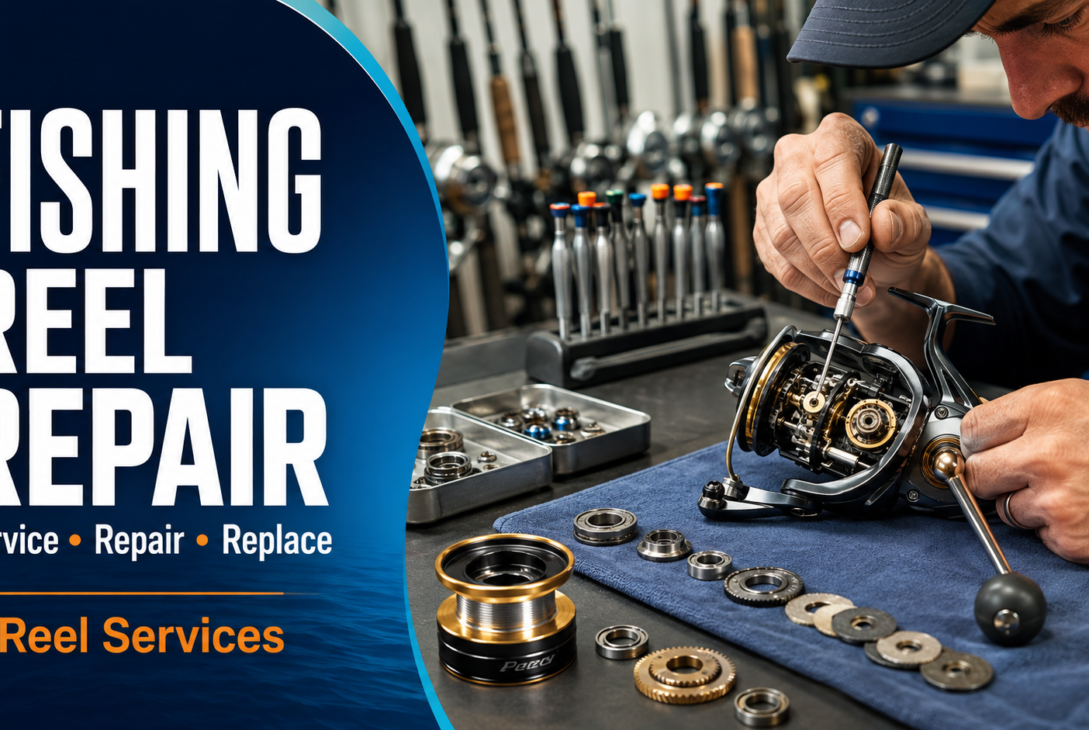
The process may include:
- Diagnosing the reported problem
- Disassembling the reel
- Cleaning internal components
- Inspecting parts for wear, corrosion, cracks, or deformation
- Checking bearings for noise or binding
- Replacing damaged drag washers
- Replacing gears, springs, bearings, handles, or other available parts
- Applying suitable oil and grease
- Reassembling the reel correctly
- Testing the handle, spool, drag, anti-reverse, bail, or level wind
A repair may address one failed part, but a technician will often find dirt, old lubricant, or corrosion that should be managed while the reel is open.
At 4 Reel Services, reels accepted for service are torn down, cleaned, inspected, lubricated, reassembled, and tested. The company states that it uses original factory parts when they are available and will discuss possible alternatives when a part has been discontinued.
Fishing Reel Service, Repair, and Maintenance: What Is the Difference?
These terms are related, but they do not always mean the same thing.
Fishing Reel Maintenance
Fishing Reel Maintenance includes routine steps used to reduce dirt, salt buildup, and wear.
Basic maintenance may involve:
- Light exterior rinsing after saltwater use
- Wiping away dirt and moisture
- Drying the reel properly
- Inspecting the line, spool, handle, and visible screws
- Applying approved lubricant only where the manufacturer recommends
- Storing the reel in a dry place
Routine care does not usually require opening the entire reel body.
Fishing Reel Service
A Fishing Reel Service is a planned inspection and internal cleaning, even if the reel has not completely failed.
It may include:
- Full or partial disassembly
- Deep cleaning
- Bearing inspection
- Gear inspection
- Drag inspection
- Lubrication
- Reassembly
- Function testing
Scheduled service can find worn parts before they cause a larger problem.
Fishing Reel Repair
Repair becomes necessary when the reel has a clear fault, damaged part, or loss of normal function.
Examples include:
- A handle that will not turn
- A reel that slips backward
- A broken bail spring
- A seized bearing
- Damaged gears
- A drag system that sticks or fails
- A level wind that does not move
- An electric reel that will not power or retrieve correctly
Fishing Reel Restoration
Fishing Reel Restoration is usually more involved. It may apply to an older, heavily corroded, discontinued, or sentimental reel.
The goal may be to return the reel to usable condition or preserve as much of its original character as possible. Parts availability often determines what can be done.
Signs Your Fishing Reel Needs Professional Attention
Reels often give warning signs before they stop working completely.
The Handle Feels Rough
A smooth reel should not feel like it contains sand when the handle turns.
Grinding, roughness, or vibration may point to:
- Dirty or dry bearings
- Gear wear
- Corrosion
- Contaminated grease
- Misaligned internal parts
- Damage caused by impact or heavy load
Continuing to fish with a rough reel may increase wear.
The Drag Sticks or Surges
The drag should release line smoothly under controlled pressure.
A drag that sticks, jerks, or changes pressure may be affected by:
- Worn drag washers
- Contamination
- Incorrect lubricant
- Corrosion
- Damaged drag surfaces
- Improper assembly
Uneven drag can lead to broken line, pulled hooks, or lost fish.
The Reel Makes New Sounds
Clicking, grinding, squealing, or rattling should not be ignored.
Some sounds come from a loose exterior part. Others begin inside the gear, bearing, anti-reverse, or level-wind system.
A Fishing Reel Diagnostic Service can help identify the source before parts are replaced.
The Anti-Reverse Slips
The anti-reverse system prevents the handle from rotating backward when the reel is under load.
If the handle slips backward, possible causes include:
- A worn one-way clutch bearing
- Contamination inside the clutch
- A damaged anti-reverse pawl
- Incorrect lubricant
- Internal wear
An Anti Reverse Reel Repair may require cleaning or replacing the affected component.
Casting Distance Drops
Reduced casting distance may be connected to:
- Dirty spool bearings
- Corrosion
- A damaged spool lip
- A braking-system issue
- Line problems
- Excessive or incorrect lubrication
- Dirt around the level wind or line guide
Not every casting problem comes from the reel. The line, lure weight, rod, wind, and casting technique should also be considered.
The Bail Does Not Work Correctly
On a spinning reel, the bail should open and close in a controlled way.
Problems may involve:
- A broken bail spring
- A bent bail wire
- Dirt or corrosion
- A damaged trip mechanism
- Loose screws
- A worn line roller
A technician may need to perform a Bail Spring Fishing Reel Repair or replace another part in the bail system.
The Level Wind Stops Moving
On reels with a level-wind system, the line guide should travel across the spool as line is retrieved.
If it stops or moves unevenly, the worm shaft, pawl, gear, or another part may be worn or blocked by debris.
The Reel Was Dropped or Submerged
Impact can bend the frame, handle, spool, or internal components. Full submersion can carry water and debris into areas that routine exterior cleaning cannot reach.
Saltwater submersion should be treated quickly because corrosion may begin inside the reel before it becomes visible.
Why Saltwater Reels Need Extra Care
Saltwater is hard on fishing equipment.
When saltwater dries, salt crystals can remain around screws, bearings, connectors, the spool, and other moving parts. Moisture trapped inside the reel may contribute to corrosion.
Shimano’s reel-maintenance guidance advises anglers to remove salt and dirt after offshore use, dry the reel, and lubricate only the recommended areas. It also warns against adding lubricant to places where it may reduce performance.
Good after-trip care may include:
- Following the manufacturer’s cleaning instructions
- Using low-pressure fresh water rather than a forceful spray
- Avoiding full submersion during routine cleaning
- Wiping the reel with a soft cloth
- Letting it dry fully before storage
- Checking for green, white, or reddish corrosion marks
- Inspecting connectors on electric reels
- Scheduling service when the reel feels different
Do not assume a sealed or water-resistant reel is maintenance-free. Seals can reduce water entry, but they do not stop every form of wear or contamination.
What Happens During a Professional Fishing Reel Service?
A professional Fishing Reel Overhaul Service is more than spraying oil around the handle.
Although the exact process depends on the reel, it may include the following stages.
1. Initial Inspection
The technician reviews the reel and the customer’s description of the problem.
Useful details include:
- When the problem began
- Whether the reel was dropped or submerged
- Whether it is used in saltwater or freshwater
- Which part makes noise
- Whether the problem occurs while casting, retrieving, or under drag pressure
- Whether a previous repair was attempted
2. Disassembly
The reel is opened in an organized way so its internal parts can be inspected.
Modern reels may contain small springs, shims, clips, seals, and washers that must return to the correct position.
3. Cleaning
Old grease, oil, salt, dirt, and debris are removed from the appropriate parts.
A Fishing Reel Deep Cleaning Service allows the technician to examine surfaces that cannot be seen during exterior cleaning.
4. Parts Inspection
The technician may check:
- Gears for worn or damaged teeth
- Bearings for noise, rust, or binding
- Drag washers for glazing, wear, or contamination
- Springs for weakness or breakage
- Screws and threads for damage
- The spool for bending or rough edges
- The anti-reverse mechanism
- The bail and line roller
- The worm shaft and level-wind pawl
- Electrical parts on powered reels
5. Parts Replacement
Replacement may be recommended when cleaning cannot restore normal function.
Common services include:
- Fishing Reel Bearings Replacement
- Fishing Reel Drag Repair
- Handle or knob replacement
- Bail spring replacement
- Gear replacement
- Anti-reverse bearing replacement
- Spool replacement
- Level-wind component replacement
- Electrical component replacement
The model number matters because parts are not interchangeable across every reel.
6. Lubrication and Reassembly
Oil and grease serve different purposes. Using too much, too little, or the wrong product can change how the reel operates.
The reel is reassembled in the correct order with attention to shims, washers, seals, and screw placement.
7. Final Testing
Before the reel is returned, key functions should be checked.
Testing may include:
- Handle movement
- Spool rotation
- Drag operation
- Anti-reverse
- Bail movement
- Level wind
- Clutch engagement
- Electrical operation
- Unusual noise or binding
Spinning Reel Repair Service
Spinning reels are widely used for freshwater, inshore, surf, and offshore fishing.
Common spinning-reel problems include:
- Bail springs that fail
- Line rollers that bind
- Rough main gears
- Noisy pinion or spool bearings
- Anti-reverse failure
- Bent spool shafts
- Drag problems
- Loose handles
- Damaged spool lips
- Corrosion under the spool or rotor
A Spinning Reel Repair Service should examine the symptom and the related parts instead of replacing components at random.
Baitcasting Reel Repair Service
Baitcasting reels depend on controlled spool rotation, braking, clutch engagement, and accurate alignment.
Common issues include:
- Reduced casting distance
- Backlash that appears suddenly
- A thumb bar that does not engage or return
- Noisy spool bearings
- A level wind that sticks
- Handle play
- Drag problems
- Gear noise under load
A Baitcasting Reel Repair Service may include bearing cleaning or replacement, brake inspection, clutch repair, gear inspection, and level-wind service.
Conventional and Offshore Reel Repair
Conventional reels are often used under heavier loads. Charter boats, offshore anglers, and tournament crews may place many hours on a reel during a season.
Problems may involve:
- Worn drag washers
- Gear wear
- Corroded bearings
- Loose handles
- Damaged harness lugs
- Level-wind problems on selected models
- Salt buildup under side plates
A planned Conventional Reel Repair Service can be easier and less costly than waiting until a reel fails under load.
Electric and Power-Assisted Reel Repair
Electric reels add motors, wiring, connectors, screens, counters, and electronic controls to the mechanical parts found in other reels.
Possible problems include:
- No power
- Intermittent operation
- Corroded connectors
- Motor problems
- Faulty switches
- Counter or display problems
- Wiring damage
- Mechanical binding
Shimano’s electric-reel care guidance warns against opening electrical components during routine maintenance and recommends removing salt and dirt promptly after use.
Electric-reel repair should be handled by a provider familiar with both the mechanical and electrical systems.
Brand-Specific Fishing Reel Repair
Reel construction, part numbers, drag systems, seals, and assembly methods vary by brand and model.
Anglers commonly search for:
- Shimano Reel Repair Service
- Daiwa Reel Repair Service
- Penn Reel Repair Service
- Abu Garcia Reel Repair Service
- Avet reel service
- Accurate reel service
- Okuma reel repair
- Tsunami reel repair
- Maxel reel repair
- Quantum reel repair
Brand familiarity matters, but the exact model is just as important.
Before sending a reel, provide:
- Brand
- Model name
- Model number
- Approximate age
- Type of use
- Description of the fault
- Warranty receipt when applicable
Daiwa’s official service page also recommends regular service and notes that parts availability may change after a model is discontinued.
Factory Parts vs. Aftermarket Parts
Original factory parts are designed for a particular reel model. They may provide the best match for dimensions, materials, and intended function.
However, parts for older or discontinued reels may no longer be available.
A repair provider should tell the customer when:
- The required factory part is available
- The part must be ordered
- The part has been discontinued
- A suitable alternative may exist
- The reel cannot be repaired safely or reliably
4 Reel Services states that it uses factory parts from the original reel manufacturer when available. Its service center handles many major reel brands and provides service for additional brands listed on its website.
Can You Repair a Fishing Reel Yourself?
Basic exterior care may be suitable for many owners when it follows the reel manufacturer’s instructions.
Simple tasks may include:
- Wiping away dirt
- Light rinsing after saltwater use
- Drying the reel
- Checking visible screws
- Applying an approved lubricant to an approved point
- Replacing a handle knob when the correct part and instructions are available
Full internal repair is different.
DIY disassembly may create problems when:
- Parts diagrams are not available
- Small springs or clips are lost
- Shims return in the wrong order
- Screws are mixed up
- The wrong lubricant is used
- Drag washers become contaminated
- A sealed body is opened incorrectly
- An electrical reel is involved
- Warranty coverage may be affected
If the reel is valuable, under warranty, heavily corroded, electrically powered, or needed for a planned trip, professional service may be the safer option.
When Is Repair Better Than Replacement?
Repair may make sense when:
- The reel is a quality model
- The frame and main structure remain sound
- Replacement parts are available
- The repair cost is reasonable compared with a new reel
- The reel has sentimental value
- The angler prefers the model’s fit and performance
- The fault is limited to serviceable parts
Replacement may be more practical when:
- The frame is badly cracked or bent
- Several major parts are damaged
- Corrosion is widespread
- Parts are discontinued and no alternative exists
- Repair cost approaches the price of a suitable new reel
- The reel no longer meets the angler’s fishing needs
A good provider should explain what was found and let the customer make an informed decision.
How Often Should a Fishing Reel Be Serviced?
There is no single schedule for every angler.
Service frequency may depend on:
- Saltwater or freshwater use
- Number of fishing trips
- Hours under load
- Charter or tournament use
- Reel type
- Storage conditions
- Exposure to sand, spray, or submersion
- Manufacturer guidance
- Changes in performance
An occasional freshwater reel may need less frequent internal service than a saltwater charter reel used several days each week.
Do not wait for a total failure if the reel begins to feel rough, noisy, weak, or inconsistent.
Care After Every Fishing Trip
A short routine after fishing may reduce avoidable damage.
Follow the manufacturer’s instructions for the specific reel. General steps may include:
- Remove loose dirt and debris
- Use gentle fresh water when recommended
- Avoid high-pressure spraying
- Do not soak the reel unless the manufacturer specifically allows it
- Wipe the exterior with a soft cloth
- Let the reel dry fully
- Check the handle, bail, spool, and line roller
- Inspect electric-reel connectors
- Store the reel in a dry, ventilated place
Avoid spraying general-purpose lubricant into every opening. Different parts require different products, and excess lubricant can carry dirt or affect the drag.
Preparing a Reel for Mail-In Service
A Mail-in Fishing Reel Repair Service allows anglers outside the local area to send reels to a repair center.
Before shipping:
- Contact the service provider or review its current shipping instructions.
- Confirm that the provider works on the brand and model.
- Record the reel’s model and serial number when available.
- Take clear photos of the reel’s condition.
- Write a short description of the problem.
- Include contact information and any required service form.
- Include proof of purchase for warranty work when requested.
- Protect the handle, spool, and body with suitable padding.
- Use a strong box with enough space for cushioning.
- Choose tracked shipping and retain the receipt.
Do not place a loose reel in a box without padding. Movement during shipping may cause damage that was not present before service.
Choosing a Fishing Reel Repair Shop
People searching for Fishing Reel Repair Near Me or a Fishing Reel Repair Shop Near Me should compare more than distance.
Ask whether the provider:
- Works on your reel brand and model
- Handles spinning, baitcasting, conventional, or electric reels
- Performs a full inspection before recommending parts
- Uses factory parts when available
- Explains what happens when parts are discontinued
- Offers warranty service for applicable brands
- Provides clear shipping instructions
- Communicates about parts delays
- Tests the reel after repair
- Has experience with saltwater damage
- Can support commercial or charter accounts when needed
Anglers who do not live near a suitable shop can also compare nationwide mail-in options.
Fishing Reel Repair in Boynton Beach, Florida
Anglers looking for Fishing Reel Repair Boynton Beach FL, Fishing Reel Service Florida, or mail-in Fishing Reel Repair USA can contact 4 Reel Services Inc..
The company services and repairs saltwater, freshwater, spinning, conventional, baitcasting, electric, and power-assisted reels. Its service page lists authorized warranty, parts, or service support for multiple manufacturers, along with repair services for additional brands.
Available work may include:
- Complete reel teardown
- Internal cleaning
- Parts inspection
- Bearing inspection
- Drag-washer replacement when needed
- Factory-parts replacement when available
- Lubrication
- Reassembly
- Final operation check
- Mail-in service
- Local drop-off options
Customers should confirm the current turnaround estimate because shipping time and parts availability can affect completion.
Fishing Reel Service From 4 Reel Services
4 Reel Services works with reels from many widely used brands, including selected Accurate, Penn, Abu, Okuma, Lew’s, Pflueger, Shakespeare, Mitchell, Maxel, Tsunami, Daiwa, Shimano, Alutecnos, Avet, and other models.
The company also services selected power-assisted reels from brands listed on its website.
To discuss a repair, parts request, drop-off, or shipping option, contact the shop with the reel’s make, model, and a clear description of the problem.
Frequently Asked Questions
Common repairs include bearing replacement, drag service, anti-reverse repair, bail-spring replacement, gear replacement, level-wind repair, handle replacement, and corrosion cleanup. The correct repair depends on inspection.
Warning signs include rough movement, new noises, reduced casting distance, weak or uneven drag, handle play, anti-reverse slipping, bail problems, and visible corrosion.
Many saltwater reels can be repaired when corrosion has not damaged too many major parts. The reel should be assessed quickly because internal corrosion may continue after the exterior dries.
The schedule depends on reel type, fishing frequency, saltwater exposure, load, and manufacturer guidance. Frequently used saltwater and charter reels generally need closer attention than reels used occasionally in freshwater.
No. Cleaning removes dirt, salt, and old lubricant. Repair corrects a mechanical or electrical fault and may require parts replacement. A service may include both cleaning and preventive inspection.
Yes, many reel bearings can be replaced when the correct size and type are available. The technician should also check why the bearing failed and whether nearby parts were affected.
Many drag problems can be corrected through cleaning, inspection, and replacement of worn washers or related parts. The reel must be tested to confirm smooth operation.
Consider parts availability, frame condition, repair cost, reel quality, sentimental value, and how the reel will be used. A technician can explain what is repairable before you decide.
Yes. Mail-in service is available from providers such as 4 Reel Services. Follow the shop’s current instructions, pad the reel carefully, include contact details and a problem description, and use tracked shipping.
Include the reel brand, model, model number, symptoms, type of use, any recent impact or submersion, previous repair attempts, contact details, and warranty receipt when applicable.
Get Your Reel Ready for the Next Trip
A reel does not have to stop completely before it receives attention.
Rough movement, weak drag, new sounds, corrosion, or inconsistent casting may be early signs that cleaning, service, or repair is needed.
Professional Fishing Reel Repair can involve full disassembly, deep cleaning, part inspection, factory-parts replacement when available, lubrication, reassembly, and testing.
To discuss a spinning, baitcasting, conventional, saltwater, freshwater, or electric reel, contact 4 Reel Services.
The shop is located at 3100 S Congress Ave., Suite 7, Boynton Beach, FL 33426. Call 1-561-509-9055 or email CustServ@4ReelServices.com with the reel make, model, and a description of the problem.
Service options, brand coverage, parts availability, pricing, and turnaround times may change. Confirm current details with the repair provider before shipping or dropping off a reel.