
If you are buying or selling a warehouse, leasing a retail space, or investing in an apartment building, the person you choose to guide you matters more than you might think. Commercial property transactions are not like buying a house. They involve large sums of money, complex contracts, and long timelines. One mistake can cost you thousands, or even millions, of dollars.
That is why learning how to choose the right real estate broker for commercial property deals is one of the most valuable skills any investor or business owner can develop. A great broker brings market knowledge, negotiation power, and a network of professionals who help close deals smoothly. A poor broker can leave you stuck with a bad location, unfair terms, or a deal that falls apart at the last minute.
In this guide, we will walk through every step of the selection process. You will learn what questions to ask, which credentials to look for, and how to avoid common pitfalls. By the end, you will feel confident in finding a broker who truly serves your best interests.
1. Define Your Specific Needs Before You Start Searching
Before you even begin interviewing brokers, you need to get clear on what you actually need. Many people skip this step and end up with a broker who is a generalist, someone who knows a little about everything but masters nothing.
Property Type Matters
Commercial real estate is not one industry. It is many different industries under one roof. A broker who excels at selling office buildings may know very little about industrial warehouses or multifamily apartment complexes. Therefore, you should seek specialists in office, retail, industrial, multifamily, or land depending on your project.
For example, if you are looking to lease a storefront for a new restaurant, find a broker who has closed at least five retail leases in the past year. Ask them about foot traffic patterns, parking requirements, and local health department rules. A specialist will answer instantly. A generalist will hesitate.
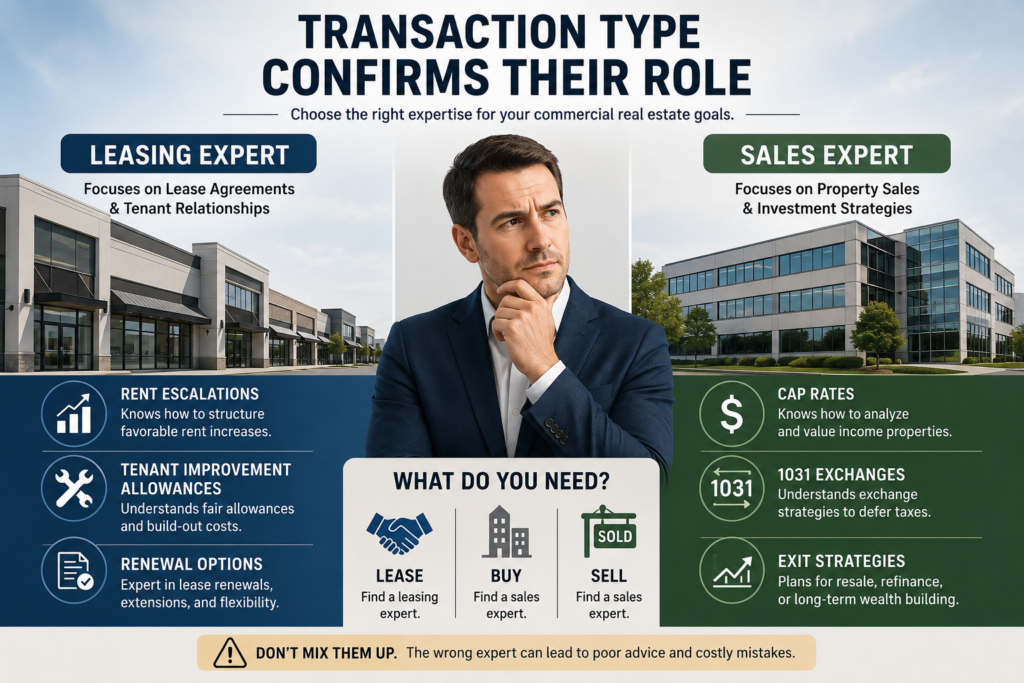
Transaction Type Confirms Their Role
Not all commercial deals are the same. Some brokers focus on leasing, while others focus on buying and selling. Before you hire anyone, confirm if you need leasing, purchasing, or selling expertise. A leasing expert understands rent escalations, tenant improvement allowances, and renewal options. A sales expert understands cap rates, 1031 exchanges, and exit strategies. If you mix them up, you will get poor advice.
Geographic Focus Ensures Local Knowledge
Real estate is local. Very local. A broker who works across three different cities may not know that one block in your target submarket has a zoning change coming next year. That information could affect your property value by 20 percent. So pick brokers with deep roots in your specific target submarket. Ask them about recent sales on individual streets. Ask about planned developments. A truly local broker will have answers ready.
2. Verify Credentials and Experience Thoroughly
Once you have a shortlist of brokers who match your property type, transaction type, and geographic focus, it is time to check their background. Do not skip this step. Anyone can claim to be an expert. You need proof.
Track Record Speaks Loudest
Ask for a list of closed deals similar to yours. Do not accept vague answers like “I have done a lot of retail deals.” Ask for addresses, dates, and deal sizes. Then, if possible, look up those properties online to confirm the information. A trustworthy broker will proudly share their track record. A broker with little experience will dodge the question.
Industry Designations Show Advanced Training
In commercial real estate, certain designations mean the broker has gone through extra education and testing. Look for credentials like CCIM (Certified Commercial Investment Member) or SIOR (Society of Industrial and Office Realtors). A CCIM designation means the broker understands financial analysis, market research, and investment valuation at a high level. An SIOR designation means the broker is a recognized expert in office or industrial properties. These are not mandatory, but they are strong signals of commitment and competence.
Licensing and Disciplinary History
Always ensure their state real estate license is active and clean. You can usually check this online through your state’s real estate commission website. Look for any past complaints, fines, or suspensions. If you find problems, move on to the next candidate.
3. Evaluate Their Market Intelligence and Data Access
In commercial real estate, information is power. The best brokers do not just look at public listings. They have access to private data, and they know how to interpret it.
Data Access Confirms Their Tools
Confirm that the broker uses top platforms like CoStar, LoopNet, and Crexi. These platforms provide detailed information on comparable sales, lease rates, vacancy trends, and property histories. A broker who does not use these tools is working with one hand tied behind their back. However, having access is not enough. Ask them to show you a sample market report. Is it clear? Is the data recent? Does it include analysis or just raw numbers?
Proprietary Insight Separates the Best from the Rest
Beyond national platforms, test their knowledge on local zoning laws and upcoming developments. Ask a question like: “What is happening with the zoning on Main Street near the old factory?” or “I heard a new transit stop is planned for the west side. How will that affect property values?” A broker with real proprietary insight will give you a detailed, confident answer. A weak broker will guess or change the subject.
Off-Market Access Finds Hidden Opportunities
The best deals are often not advertised. Ask every broker how they find deals not listed on public databases. Do they have relationships with local owners? Do they attend industry events where off-market properties are discussed? Do they send out direct mail campaigns? A broker who relies only on public listings will show you what everyone else can already see. A broker with off-market access can show you opportunities before they hit the open market.
4. Assess Their Network and Resources
No broker works alone. Even the most talented individual cannot provide everything you need. You need a broker who sits at the center of a strong professional network.
Analyst Support for Complex Modeling
Commercial deals often require detailed financial analysis. Cash flow projections, internal rate of return calculations, and sensitivity analysis are common needs. Ensure your broker has a team to handle deep financial modeling. If it is just one person doing everything, they may make mistakes or take too long. A firm with analyst support can produce accurate numbers quickly.
Vendor Connections Save Time and Money
You will also need lenders, inspectors, environmental consultants, and attorneys. Ask your broker about their network of trusted lenders, inspectors, and attorneys. A well-connected broker can refer you to professionals who are honest, efficient, and fairly priced. This saves you from picking names at random from the internet. One note of caution: make sure the broker is not receiving hidden referral fees. Ask directly. A transparent broker will tell you exactly how they work with vendors.
Tenant and Buyer Pool for Sellers
If you are selling a property, you should ask about the broker’s direct database of active buyers. How many qualified buyers do they talk to every week? Do they have a list of investors looking for exactly your type of property? A broker with a strong buyer pool can create competition, which drives up your sale price. A broker without that pool will have to rely entirely on public marketing, which takes longer and often yields lower offers.
5. Review the Fee Structure and Agency Relationships Carefully
Money and loyalty. These two topics make many people uncomfortable, but you must discuss them openly before signing anything.
Dual Agency Creates Potential Conflicts
Dual agency means one broker represents both the landlord and the tenant (or both the buyer and the seller) in the same transaction. This can create conflicts of interest because the broker cannot fully advocate for both sides at the same time. Clarify if the broker represents both landlords and tenants. If they practice dual agency frequently, ask them to explain how they manage conflicts. Some states restrict or ban dual agency. Know your local rules.
Commission Split Clarifies Who Pays
Understand who pays the fee and how it is shared. In most commercial deals, the seller or landlord pays the commission. However, there are variations. Sometimes a tenant or buyer pays a separate fee. Sometimes commissions are split between two brokers. Ask for a clear written explanation before you do any work together. Do not rely on verbal promises.
Contract Terms Protect Your Flexibility
Finally, review the exclusivity period and termination clauses before signing any agreement. An exclusivity period is a length of time during which you cannot work with another broker. This is normal, but the length should be reasonable. For a simple lease, 60 to 90 days may be fine. For a large investment sale, six months might be acceptable. More important than the length is the termination clause. Can you end the agreement early if the broker is not performing? What specific steps must you take to cancel? A fair contract protects both parties. A one-sided contract is a red flag.
Putting It All Together
Learning how to choose the right real estate broker for commercial property deals is not complicated, but it does require patience and attention to detail. Start by defining your needs around property type, transaction type, and geography. Then verify credentials and track record. Next, test their market intelligence and data access. After that, assess their network and team resources. Finally, review the fee structure and contract terms carefully.
Take your time with this process. Interview at least three brokers. Ask the same questions to each one. Compare their answers side by side. A great broker will welcome your questions because they know their value. A poor broker will rush you or avoid details.
Remember, the right broker does more than just show you properties. They protect your interests, uncover hidden risks, negotiate fiercely on your behalf, and help you avoid costly mistakes. In the world of commercial property deals, that kind of partnership is worth more than any single fee.
So do your homework. Ask the hard questions. Trust your instincts. And then move forward with confidence, knowing you have chosen a true professional to guide you through one of the biggest financial decisions of your life.