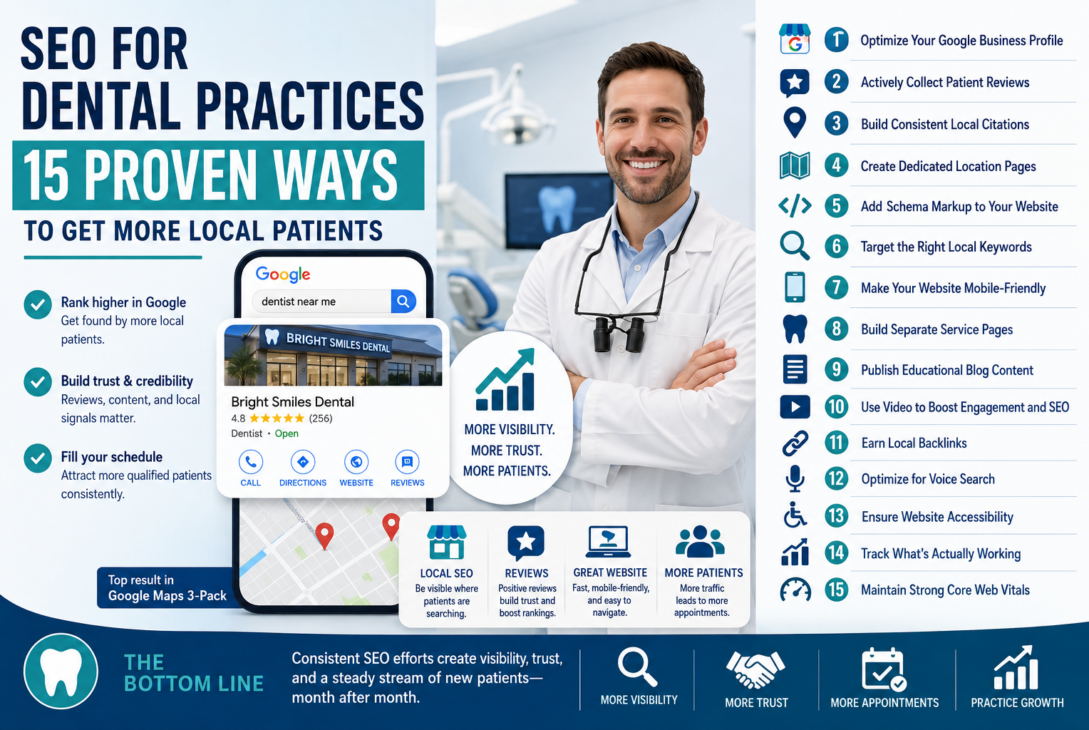
If your dental practice isn’t showing up on the first page of Google, you’re losing patients to competitors every single day. Most people searching for a dentist click one of the top three results. If you’re not there, you’re invisible.
The good news? SEO for dental practices doesn’t have to be complicated. With the right strategy, you can attract more local patients, build trust online, and fill your appointment book consistently. Here are 15 proven ways to make it happen.
1. Optimize Your Google Business Profile
Your Google Business Profile (GBP) is often the first thing patients see. Claim and verify your listing, then make sure your Name, Address, and Phone number (NAP) exactly match your website.
Choose precise categories like “Dentist” or “Cosmetic Dentist.” Upload high-quality photos of your office, staff, and treatment rooms. Keep your hours current, including holidays. An incomplete or inaccurate profile costs you clicks and credibility.
2. Actively Collect Patient Reviews
Online reviews directly influence your local rankings and patient decisions. Ask satisfied patients for a Google review right after their appointment; timing matters.
Follow up with an automated SMS containing a direct review link. When reviews come in, respond to every one professionally, both positive and negative, while staying HIPAA-compliant. A steady flow of fresh reviews signals trustworthiness to both patients and search engines.
3. Build Consistent Local Citations
A citation is any mention of your practice’s NAP information across the web. List your practice on healthcare directories like Healthgrades, Vitals, and WebMD, as well as local platforms like Yelp and YellowPages.
Consistency is critical. Even minor differences, such as an old phone number or a slightly different address format, can hurt your rankings. Audit your existing listings regularly and fix any mismatches.
4. Create Dedicated Location Pages
If you operate multiple locations, each one needs its own landing page with a unique URL. Generic “Contact Us” pages don’t cut it for local SEO.
Each page should include an embedded Google Map, your local address and phone number, and content that references nearby landmarks, neighborhoods, or transit options. This tells Google exactly where you serve patients.
5. Add Schema Markup to Your Website
Schema markup is structured code that helps search engines understand your content. Use the Dentist Schema to provide Google with details like your hours, services, and location.
Adding an aggregate rating schema can display star ratings directly in search results, giving patients a reason to click before they even visit your site.
6. Target the Right Local Keywords
Generic keywords like “dentist” are too broad. Focus on high-intent, localized terms like “dentist near me,” “family dentist in [City Name],” or “Invisalign [City Name].”
Map each keyword to a specific page on your site. Place city names naturally in your title tags, meta descriptions, and page copy. Forced keyword placement hurts both readability and rankings.
7. Make Your Website Mobile-Friendly
More than 60% of local searches happen on mobile devices. If your site loads slowly or feels clunky on a phone, patients will leave and choose a competitor.
Compress images to speed up load times, add a sticky “Click-to-Call” button at the top of mobile screens, and simplify appointment forms to just a few fields. Every friction point costs you a potential booking.
8. Build Separate Service Pages
A single “Services” page is a missed SEO opportunity. Create individual pages for procedures like dental implants, root canals, Invisalign, and teeth whitening.
Each page should explain the procedure clearly, answer common questions, address patient concerns, and mention insurance or financing options. These pages rank individually for procedure-specific searches, and convert better, too.
9. Publish Educational Blog Content
A consistent blog builds your authority and attracts patients early in their research process. Write about topics your patients actually search for, things like “why do my gums bleed when I brush” or “what to expect during a root canal.”
Update content seasonally (back-to-school checkups in August, holiday dental tips in December) to stay relevant and give Google a reason to keep crawling your site.
10. Use Video to Boost Engagement and SEO
Video content keeps visitors on your site longer, which signals quality to Google. Film a short office tour to ease patient anxiety, or share genuine patient testimonials on YouTube and embed them on your website.
Optimize every video with your city name and relevant keywords in the title, description, and tags. This extends your SEO reach to YouTube, the world’s second-largest search engine.
11. Earn Local Backlinks
Backlinks from trusted local websites tell Google your practice is an established part of the community. Sponsor a local youth sports team or charity event to earn a link from their website.
Join your local Chamber of Commerce and get listed in their directory. Offer to write a dental health guest post for a regional parenting or lifestyle blog. Each link adds authority to your domain.
12. Optimize for Voice Search
Patients increasingly use voice assistants to find local services. Queries like “Who is the best dentist near me?” are conversational and longer than typed searches.
Add an FAQ section to your homepage with short, direct answers written in natural language. This format aligns well with how voice search results are selected, and it helps with featured snippets, too.
13. Ensure Website Accessibility
Accessibility isn’t just ethical, it’s an SEO signal. Following WCAG guidelines ensures your site works for visually impaired users and those using screen readers.
Use high-contrast text colors for readability, especially for older patients. Enable full keyboard navigation throughout your booking flow. An accessible site reaches more patients and signals professionalism to search engines.
14. Track What’s Actually Working
You can’t improve what you don’t measure. Set up Google Analytics and Google Search Console to track how patients find and interact with your site.
Use a call tracking tool like CallRail to see which keywords and pages generate phone calls. Monitor your position in the Google Maps 3-Pack, that’s the map section that appears at the top of local search results and drives the majority of local clicks.
15. Maintain Strong Core Web Vitals
Google officially uses Core Web Vitals as a ranking factor. These metrics measure how fast, stable, and responsive your site feels to real users.
Fix layout shifts that cause elements to jump around while a page loads. Choose a fast, reliable hosting provider built for medical or professional websites. Remove unused JavaScript and CSS to trim load times. A site that feels fast earns better rankings and keeps patients from bouncing.
The Bottom Line
Effective SEO for dental practices isn’t a one-time task; it’s an ongoing system. Start with the fundamentals: your Google Business Profile, local citations, and service pages. Then layer in content, reviews, backlinks, and technical improvements over time.
Each step compounds on the last. A practice that invests consistently in local SEO doesn’t just rank higher; it builds a steady, reliable stream of new patients month after month.