Calgary landscaping is shifting toward outdoor spaces that do more than look good in summer. In 2026, homeowners are increasingly looking for yards that are functional, lower-maintenance, water-conscious, and durable enough to handle Alberta’s changing conditions. That means better planning, thoughtful material selection, drainage, grading, and landscape designs suited to the local climate.
For Calgary homeowners, the biggest trend is not a particular colour, paving pattern, or plant. It is building outdoor spaces that continue to perform after years of freeze-thaw cycles, heavy precipitation, dry periods, and seasonal temperature swings.
What Are the Biggest Calgary Landscaping Trends in 2026?
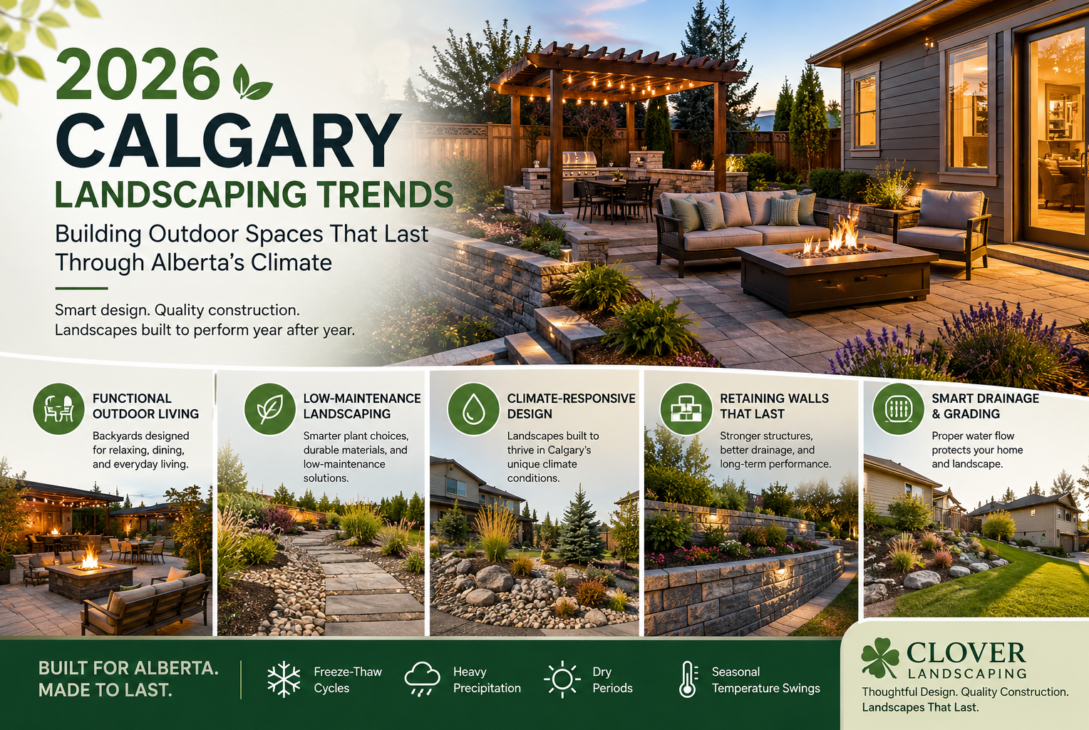
The strongest trends combine aesthetics with practical performance. Outdoor living spaces are becoming more purposeful, while homeowners are paying closer attention to maintenance, water use, and how materials respond to Calgary’s weather.
1. Functional Outdoor Living Spaces
Backyards are increasingly being planned as extensions of the home rather than simply areas of lawn. Larger patios, defined seating areas, outdoor dining spaces, walkways, and landscaped gathering areas can make a property more useful throughout the warmer months.
The goal is not necessarily to add every possible feature. A well-designed patio with comfortable access, appropriate drainage, and enough space for the way a family actually lives can provide more value than an oversized collection of disconnected features.
Recent Calgary landscaping coverage also points toward larger, more functional hardscape areas designed around entertaining and everyday outdoor use.
2. Low-Maintenance Landscaping
Busy homeowners are looking for landscapes that require less ongoing work without sacrificing appearance.
This can mean reducing unnecessary lawn areas, using decorative rock in appropriate locations, choosing durable hardscape materials, and selecting plants that are better adapted to local conditions. It does not mean eliminating greenery. Instead, the landscape is designed so that each element has a purpose.
The City of Calgary recommends water-wise plants, quality soil, mulch, and efficient watering practices as part of a climate-ready yard.
3. Climate-Responsive Landscape Design
A major 2026 trend is designing around the property rather than forcing a generic design onto it.
Calgary’s weather can challenge both plants and hardscape construction. A landscape needs to account for drainage, changing temperatures, soil conditions, sun exposure, and water availability.
That makes landscape construction in Calgary fundamentally different from simply choosing attractive materials from a catalogue.
How Does Alberta’s Climate Affect Landscape Construction?
Climate should influence the project from the planning stage, not after problems appear.
Freeze-Thaw Conditions
Repeated freezing and thawing can put stress on patios, walkways, retaining walls, and other hardscape features. Poor preparation can contribute to movement, settlement, or drainage problems.
For this reason, proper excavation, aggregate preparation, grading, compaction, and drainage are essential when building durable outdoor spaces.
Clover Landscaping’s documented construction process, for example, includes precise grade measurements, excavation, compacted aggregate, limestone fines, and careful paver installation.
The broader lesson for homeowners is simple: the part of a patio you cannot see is often just as important as the pavers you can see.
Drainage Matters More Than Appearance
A beautiful landscape can still become a costly problem if water is directed toward the wrong areas.
The City of Calgary recommends positive drainage away from home foundations and warns that poor lot grading can allow water to collect beside foundation walls.
That makes grading an important part of both new landscaping and backyard renovations. Before choosing materials or planting layouts, homeowners should understand where water currently flows and where it should go.
Why Are Retaining Walls Becoming More Important in Calgary?
Retaining walls are more than decorative landscape features. They can help manage changes in elevation, define usable areas, and make sloped properties more functional.
A properly planned retaining wall installation in Calgary should consider the existing grade, drainage, soil conditions, wall materials, and the loads acting around the structure.
The wall itself is only one part of the system. Its foundation and drainage strategy play a major role in long-term performance.
For homeowners considering a retaining wall, useful questions include:
- Where will water go after heavy rainfall?
- What type of wall system suits the property?
- How will the wall interact with existing grades?
- What preparation is required below the finished surface?
- Does the project require additional approvals or engineering?
The answers depend on the individual site, so a professional assessment is more useful than choosing a wall based solely on appearance.
How Can Calgary Homeowners Make Their Yards More Water Efficient?
Water-efficient landscaping does not have to mean a barren or unattractive yard.
Calgary recommends drought-tolerant vegetation, adequate topsoil, mulch, rainwater collection, and directing runoff toward suitable landscaped areas.
Use Plants That Match the Site
Instead of choosing plants first and trying to make the property accommodate them, consider sunlight, soil moisture, exposure, and available space.
Plants suited to local conditions generally require less intervention once established.
Improve Soil and Mulch Garden Beds
The City recommends a minimum of eight inches of good-quality soil in relevant landscaping applications to improve moisture retention and drainage. Mulch can also reduce evaporation and help maintain more consistent soil moisture.
Reduce Unnecessary Irrigation
Watering practices matter just as much as plant selection. Calgary recommends watering during cooler periods and using methods such as drip irrigation where appropriate.
Are Patios and Walkways Still a Major 2026 Trend?
Yes, but the focus is moving from simply installing a patio to creating a more integrated outdoor space.
A patio can become the foundation for an outdoor dining area, seating zone, fire feature, or connection between different parts of the yard. Walkways can also do more than provide access. They can establish circulation patterns and visually connect the home with the landscape.
For patio installation in Calgary, durability should remain a priority. Material selection, base preparation, grading, drainage, edge restraint, and installation practices all influence how the finished surface performs over time.
Clover Landscaping’s documented approach uses measured grades and a prepared aggregate base before the final leveling and paver installation.
What Does a Durable Calgary Landscape Look Like?
A durable landscape does not necessarily look industrial or overly engineered. Good construction can be almost invisible once the project is complete.
The best results usually come from matching several elements:
A Strong Foundation
Patios, walkways, and landscape steps need appropriate base preparation. Clover Landscaping’s documented landscape-step process, for example, uses a compacted aggregate sub-base installed in layers before the finished surface is added.
Thoughtful Grading
The finished landscape should work with the property’s drainage rather than fight it.
Appropriate Materials
Materials should suit the property’s use, exposure, grade, and maintenance expectations not simply the homeowner’s preferred appearance.
Design That Fits Real Life
A backyard used for family dinners needs different priorities from one designed mainly for children, pets, gardening, or quiet relaxation.
That user-first approach is one of the most practical Calgary landscaping trends for 2026.
How Should You Plan a Calgary Landscape Project in 2026?
Start with the property rather than Pinterest.
Before selecting materials or finalizing a design, consider:
- How do you use the yard now?
- What problems need to be solved?
- Where does rainwater currently flow?
- Which areas receive full sun, shade, or strong wind?
- How much maintenance are you realistically willing to do?
- Which features will still be useful five or ten years from now?
A professional landscape planning process can help turn those answers into a practical design. Clover Landscaping’s stated process includes an on-site consultation, property surveying, material and layout recommendations, a customized estimate, project scheduling, construction, and a final walkthrough.
That level of planning helps prevent a common mistake: designing a landscape around individual features instead of designing the entire property as one connected system.
The Real 2026 Landscaping Trend: Build for the Long Term
The most valuable trend in Calgary landscaping is not a particular plant, paver colour, or backyard feature. It is a move toward better-performing landscapes.
Homeowners are increasingly looking for outdoor spaces that combine comfort with practical construction, efficient water use, manageable maintenance, and materials appropriate for Alberta’s conditions.
Whether the project involves a new patio, retaining wall, walkway, grading, artificial turf, sod, or a complete backyard renovation, the same principle applies: design for the climate first, then build around the way you want to use the space.
That approach creates landscapes that are not only attractive when they’re newly completed but remain useful and functional as Calgary’s seasons continue to change.
FAQs About Calgary Landscaping Trends
1. What are the biggest Calgary landscaping trends in 2026?
Major trends include functional outdoor living spaces, low-maintenance landscaping, climate-responsive design, water-efficient yards, durable hardscaping, and landscaping planned around local site conditions.
2. What landscaping is best for Calgary’s climate?
The right solution depends on the property, but climate-adapted plants, appropriate soil preparation, effective drainage, durable hardscape construction, and water-efficient landscaping can improve long-term performance in Calgary.
3. How can I make my Calgary backyard low maintenance?
Consider reducing unnecessary lawn areas, choosing appropriate plants, using mulch or decorative rock where suitable, and designing patios and walkways that require limited ongoing care.
4. Why is drainage important for Calgary landscaping?
Proper drainage helps direct water away from structures and prevents unwanted ponding. Calgary specifically recommends positive lot drainage that moves water away from home foundations.
5. Are retaining walls a good option for Calgary properties?
Retaining walls can be useful for managing changes in elevation, creating usable areas, and controlling slopes. Their suitability depends on site conditions, drainage, wall design, and construction requirements.
6. How do I build a patio that lasts in Calgary?
A durable patio starts with proper site preparation, excavation, grading, a stable compacted base, appropriate leveling material, and careful installation. Material selection should also account for how the patio will be used and exposed to Calgary’s conditions.
7. What should I consider before starting a Calgary landscaping project?
Consider drainage, grading, soil, sunlight, maintenance requirements, intended use, material durability, and the long-term needs of the property before finalizing the design.