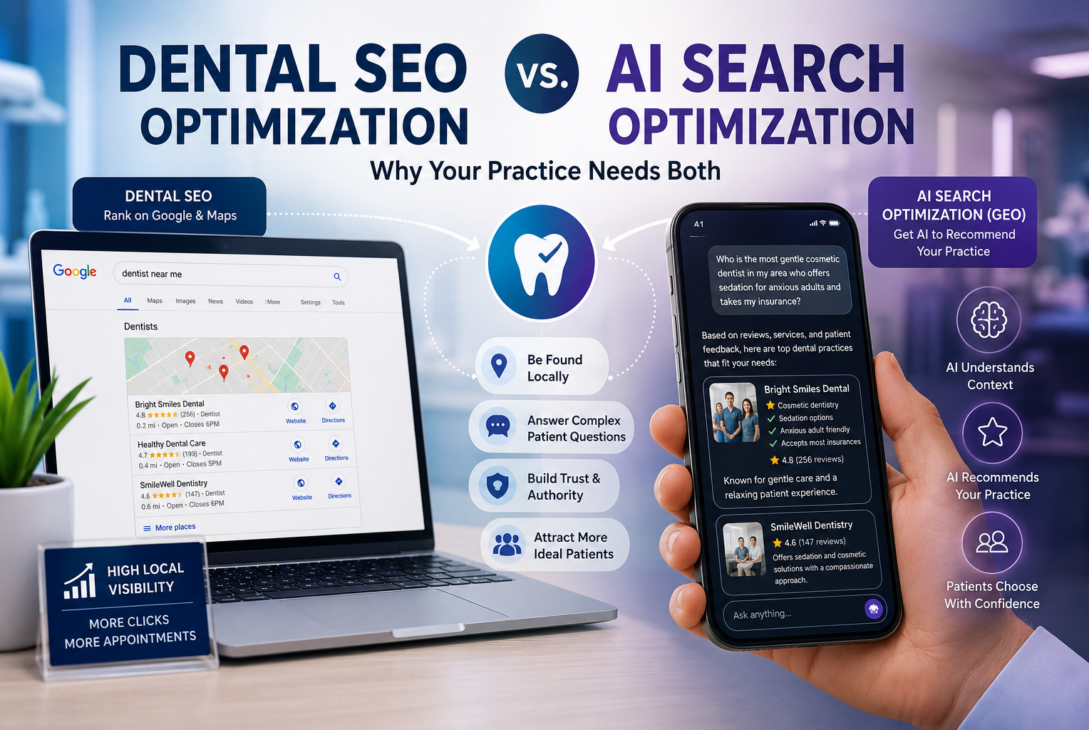
Imagine a prospective patient sitting down at their laptop. A few years ago, they would type “dentist near me” into Google, scroll through the local map pack, check a couple of 4.5-star reviews, and call the first clinic listed.
Today, that same patient opens ChatGPT or Google Gemini and types a far more specific question: “Who is the most gentle cosmetic dentist in my area who offers sedation for anxious adults and takes my insurance?”
Instead of a page of blue links, the AI gives them a synthesized, conversational recommendation naming two specific clinics—and explains why they fit the patient’s exact needs.
This shift marks the transition from traditional search engine optimization to AI search optimization for dentists. However, replacing your existing marketing strategy isn’t the answer. To dominate local search today, your dental practice must combine traditional local SEO with modern Generative Engine Optimization (GEO).
What is Dental SEO?
Dental SEO is the process of optimizing your practice’s website and online profiles to rank higher in standard search engine results pages (SERPs) like Google and Bing.
[ Traditional Dental SEO ] ──► Rank higher on Google Maps & blue links ──► Direct clicks to your site
Traditional SEO focuses heavily on technical performance, keyword placement, and geographic proximity. When patients search for broad, high-intent terms like “emergency dentist” or “teeth whitening cost,” local SEO ensures your practice appears front and center.
Key elements of traditional dental SEO include:
- Google Business Profile (GBP): Managing your local map pack presence.
- Local Keywords: Target phrases like “pediatric dentist in [City].”
- On-Page Optimization: Structuring title tags, meta descriptions, and headers.
- Technical Health: Ensuring fast page load speeds and seamless mobile responsiveness.
Traditional SEO captures patients who know exactly what service they need and are looking for a quick, nearby solution.
What is AI Search Optimization (GEO)?
AI Search Optimization—often called Generative Engine Optimization (GEO)—is the practice of optimizing your clinic’s entire digital footprint so conversational AI tools recommend your practice when users ask complex questions.
Instead of matching keywords to search queries, engines like ChatGPT, Google Gemini, and Perplexity read content across the web to understand context, clinical expertise, and patient sentiment.
[ AI Search Optimization ] ──► Synthesize web data & reviews ──► AI recommends your clinic directly
Key elements of AI search optimization for dentists include:
- Conversational Context: Optimizing for long-tail, natural language questions.
- Entity Association: Ensuring AI links your practice to specific treatments, tools, and specialties.
- Cross-Web Consensus: Aligning reviews, directory listings, and news mentions so AI trusts your practice data.
- Zero-Click Answers: Providing clear, concise facts that AI engines can quote directly in their summaries.
Dental SEO vs. AI Search Optimization: A Direct Comparison
While both strategies aim to bring new patients into your dental chair, they approach discovery differently:
| Feature | Traditional Dental SEO | AI Search Optimization (GEO) |
| Primary Goal | Top rankings on Google SERPs & Maps | Direct AI mention and recommendation |
| User Search Behavior | Short keywords (“Invisalign cost”) | Long, conversational queries (“Is Invisalign better than braces for adults with deep overbites?”) |
| Key Ranking Factors | Backlinks, site speed, local citations | Brand mentions, detailed reviews, structured data |
| User Experience | Clicks through to your website | Receives a direct answer inside the AI interface |
| Target Intent | Immediate, action-oriented booking | Research-heavy, multi-criteria decision making |
Why Traditional Dental SEO Still Matters
With all the excitement surrounding artificial intelligence, it is tempting to shift your entire budget toward AI search optimization for dentists. Doing so would be a mistake. Traditional SEO remains the bedrock of online visibility for three key reasons:
1. Dominating Local Intent
When a patient chips a tooth, they do not ask AI for a detailed breakdown of dental composite materials. They search “emergency dentist near me” on their phone. Google Maps still drives the vast majority of immediate local appointments.
2. SEO Provides the Data AI Crawls
AI search models do not generate facts out of thin air. They crawl existing, highly ranked websites to learn about dental procedures, pricing, and practice details. If your website lacks strong technical SEO foundations, AI crawlers will skip over your content entirely. You can verify how search engine crawlers interpret your site’s structure using Google Search Central’s technical guidelines.
3. Review Aggregation and Social Proof
Traditional SEO strategies prioritize collecting reviews on high-authority platforms like Google Business Profile and Yelp. AI search engines rely heavily on these review aggregators to gauge your clinic’s reputation before making a recommendation.
Why Your Practice Needs AI Search Optimization
While traditional SEO brings patients to your digital front door, GEO ensures you aren’t left out of the conversation as search habits evolve. According to industry analysis on search trends from Search Engine Land, millions of users now consult conversational engines as personalized research assistants.
Managing Complex Patient Queries
Patients frequently ask AI tools nuanced questions that traditional search engines handle poorly. A query like “Which dental office in town is best for children with sensory sensitivities?” requires the search tool to analyze patient reviews, team bio pages, and community mentions to form a helpful response.
The Rise of Zero-Click Searches
AI engines deliver complete answers directly in the search interface. If an AI tool can summarize your practice’s expertise, location, and office hours without requiring a click, you gain instant trust from the user.
Competitive Advantage
Most local dental practices still rely exclusively on basic keyword optimization. Implementing early GEO techniques allows your clinic to capture high-value patients who use advanced AI platforms to choose specialized care providers.
How SEO and GEO Work Together
Rather than viewing these approaches as competing options, treat them as a unified marketing ecosystem. SEO builds the data pipeline, and AI Search Optimization extracts the context to recommend your clinic.
[ High-Quality SEO Content ] + [ Structured Schema Markup ]
                            │
                            ▼
           [ AI Crawlers Scrape & Learn ]
                            │
                            ▼
       [ AI Recommends Your Practice to Patients ]
- SEO builds authority: Your optimized service pages and blog posts establish high search engine trust.
- Schema adds clarity: Structured code helps AI bots parse exact details like accepted insurance, office hours, and credentials.
- GEO builds context: AI synthesizes your online presence, linking your practice to high patient satisfaction and specialized clinical expertise.
Action Plan: Combine SEO and GEO for Your Dental Clinic
Ready to modernize your digital marketing strategy? Implement these practical steps to optimize your practice for traditional search engines and AI recommendation engines alike:
1. Maintain Core SEO Foundations
Keep your technical SEO in top shape. Ensure your website loads quickly, displays correctly on mobile devices, and target location-specific keywords across your primary service pages.
2. Implement Dental Schema Markup
Add structured data markup (Schema.org) to your website code. This backend code explicitly tells search bots and AI models your exact business name, physical location, operational hours, accepted payment methods, and specific treatments offered.
3. Publish Comprehensive, In-Depth Content
Move beyond short 300-word service descriptions. Write comprehensive guides that address real patient questions:
- Explain procedural steps clearly.
- Detail recovery times and post-care instructions.
- Outline potential costs and financing options.
The more thoroughly you answer complex questions on your blog, the more likely AI engines are to reference your content as an authoritative source.
4. Keep Business Citations Consistent
Inconsistent NAP (Name, Address, Phone number) data confuses both Google and AI models. Regularly audit your business listings across platforms like Google Maps, Healthgrades, Yelp, Vitals, and Apple Maps to ensure every detail matches perfectly.
5. Cultivate Detailed Patient Reviews
Encourage satisfied patients to write descriptive reviews. A review that says “Dr. Smith was great!” is nice for star ratings. However, a review stating “Dr. Smith made my root canal completely painless using their 3D imaging tech” gives AI models explicit keywords to match with complex patient queries.
Future-Proof Your Dental Practice Today
Search behavior is evolving rapidly, but the core objective of dental marketing remains unchanged: connecting patients with quality, compassionate care.
By combining the local reach of traditional Dental SEO with the targeted precision of AI search optimization for dentists, you protect your practice from shifting search trends. Focus on clear structured data, rich clinical content, and authentic patient feedback to ensure your clinic remains the top recommendation—whether a patient asks Google or an AI assistant.