Building a swimming pool is a major investment, and choosing the right contractor can have a significant impact on the entire experience. From design and permitting to excavation, plumbing, electrical work, and finishing, a pool project involves many moving parts.
The right Swimming Pool Construction Company should offer more than an attractive design and a competitive price. You need a builder with the experience, credentials, communication, and project-management skills to turn your backyard vision into a properly constructed pool.
If you are comparing contractors, use the following checklist to evaluate each company before signing a contract.
1. Check the Company’s Experience and Reputation
Start by looking at how long the company has been involved in pool construction and what types of projects it has completed.
An established pool construction company should be able to show you examples of completed projects that are similar to what you have in mind. Look for experience with the pool style, features, materials, and property conditions relevant to your project.
Don’t rely only on photos. Read recent reviews, look at customer feedback, and ask whether the builder can provide references from previous clients.
The Pool & Hot Tub Alliance recommends considering a builder’s experience, references, customer reviews, portfolio, and professional credentials when evaluating potential contractors.
2. Verify Licensing and Insurance
Before allowing construction to begin, verify that the contractor is properly licensed and insured.
Ask for documentation showing the company’s current license and insurance coverage. General liability insurance can help protect your property from covered damage, while workers’ compensation coverage helps address workplace injuries involving employees.
A professional Swimming Pool Construction Company should be comfortable providing this information. PHTA also recommends confirming licensing and both liability and workers’ compensation insurance before hiring a pool builder.
You can also ask whether the builder maintains any industry certifications or professional affiliations. These credentials don’t replace proper licensing, but they can provide additional information about a company’s commitment to professional education.
3. Review the Builder’s Portfolio
A portfolio can tell you a lot about a contractor’s capabilities.
Look beyond the most impressive project in the company’s marketing materials. Review several completed pools and see whether the builder has experience creating different layouts, elevations, finishes, outdoor features, and equipment configurations.
This is particularly important if you want custom swimming pool construction rather than a basic, predetermined design.
For example, custom projects may include attached spas, tanning ledges, water features, fire elements, outdoor living areas, automation, and specialized lighting. A builder should be able to explain how these features can work together with your home’s architecture and available yard space.
4. Make Sure the Design Is Actually Custom
A quality custom pool builder should design the project around your property and lifestyle instead of simply fitting a standard pool into the available space.
During the consultation, discuss how you expect to use the pool. Will it primarily be used for entertaining, relaxing, exercise, or family activities? Your answers should influence the pool’s size, shape, depth, features, and surrounding outdoor space.
PHTA recommends considering factors such as budget, backyard space, lifestyle, pool type, and intended use when planning a pool.
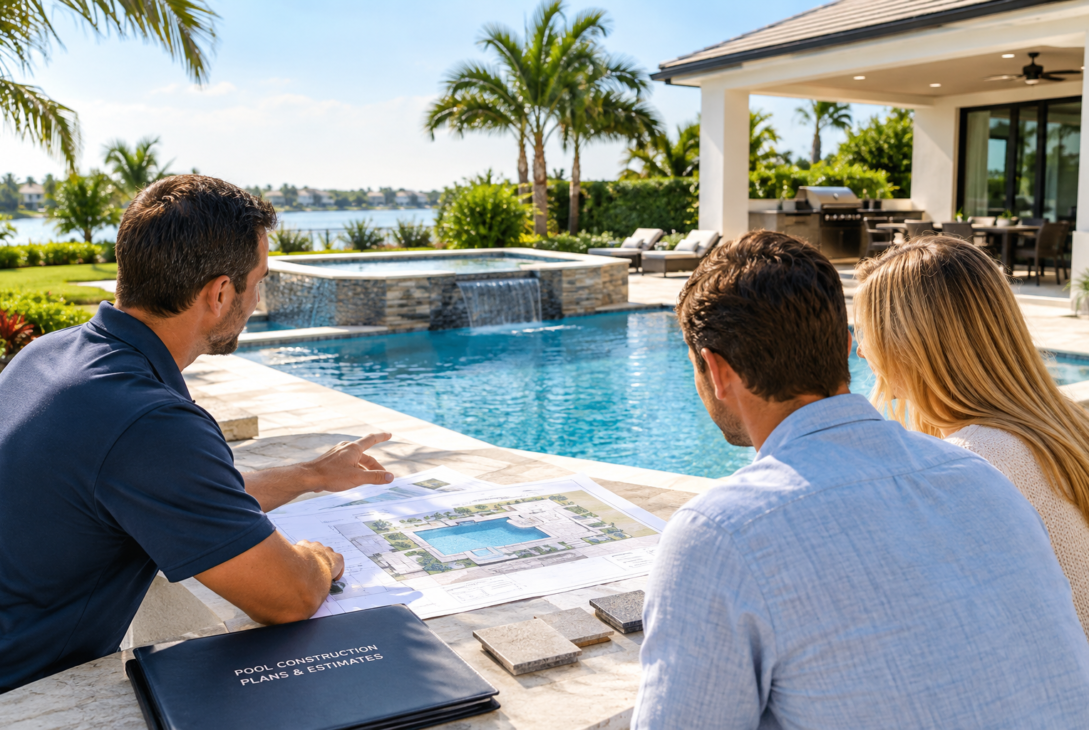
Ask whether the company provides detailed designs, site evaluations, 3D renderings, or other tools that help you understand the finished project before construction begins.
5. Ask Who Will Manage the Construction
Pool construction involves several phases, including excavation, structural work, plumbing, electrical systems, equipment installation, finishes, and final inspections.
Ask who will coordinate these stages and who your primary point of contact will be throughout the project.
If subcontractors are involved, find out which parts of the project they handle and how the builder supervises their work. Clear project management can make it easier to identify responsibilities and resolve problems when they arise.
A well-organized builder should also explain the major construction milestones and provide a realistic timeline.
6. Get a Detailed Written Estimate
Never compare pool builders based solely on the final price.
A detailed estimate should explain what is included in the project. Depending on the scope, this may include design, engineering, permits, excavation, structural construction, plumbing, electrical work, equipment, interior finishes, decking, and other features.
Ask questions about anything that is unclear. If one quote is dramatically lower than another, determine why before making a decision.
A lower initial price may not represent the same scope of work. PHTA recommends accounting for construction, permits, design, engineering, and potential unexpected costs when planning a pool budget.
7. Understand the Contract and Payment Schedule
Before signing, carefully review the contract.
The agreement should identify the project scope, payment schedule, estimated timeline, materials, warranties, change-order procedures, and responsibilities of both parties.
Avoid making assumptions about features that are discussed verbally but do not appear in the written agreement.
Ask how changes will be handled if you decide to add a feature or modify the design during construction. Understanding this process beforehand can help prevent disagreements later.
8. Ask About Equipment and Warranties
Your pool’s equipment plays an important role in long-term performance.
Ask which pumps, filters, heaters, automation systems, lighting, and sanitation equipment the builder recommends. More importantly, ask why those products are appropriate for your pool.
You should also understand which warranties come from the manufacturer and which responsibilities are covered directly by the builder.
A reputable contractor should explain warranty coverage, what is excluded, and how you would make a claim if a problem occurs. PHTA specifically recommends reviewing warranty length, coverage, the claims process, and the builder’s reputation for honoring warranties.
Pool Builder Checklist: Red Flags to Watch For
When comparing a residential pool builder, pay attention to warning signs that could create problems later.
Be cautious if a contractor:
- Cannot provide current licensing or insurance documentation
- Gives you an unusually vague estimate
- Pressures you to sign immediately
- Cannot show comparable completed projects
- Avoids explaining who performs the construction work
- Requests unclear or unusually large upfront payments
- Makes major changes to the project without written documentation
- Provides unrealistic completion promises
None of these points alone proves that a contractor is unreliable, but they are reasons to ask additional questions before moving forward.
Choose a Builder That Provides Clear Communication
Good communication matters just as much as construction expertise.
Your builder should explain what happens next, provide updates during construction, and make it easy for you to ask questions. You should know who to contact when you have a concern and how project decisions will be documented.
For homeowners in South Florida, Bold Water Custom Pools provides custom pool construction, renovations, remodels, and outdoor living upgrades throughout Palm Beach, Martin, and St. Lucie Counties. The company describes its process as covering design, permitting, construction, project management, and final walkthrough.
You can also review the company’s pool construction services and completed projects to see examples of its work.
Final Thoughts
Choosing a Swimming Pool Construction Company should involve more than comparing prices. Look at experience, licensing, insurance, design capabilities, construction management, written estimates, equipment, warranties, reviews, and communication.
A thorough pool builder checklist can help you compare contractors based on the details that matter throughout the entire project—not just during the initial sales conversation.
If you’re planning a custom pool in Palm Beach, Martin, or St. Lucie County, start by discussing your property, goals, budget, and design ideas with an experienced builder. Contact Bold Water Custom Pools to schedule a consultation and discuss your pool project.