
Real estate decisions can make or break a company’s bottom line. A single bad lease or a poorly timed acquisition can tie up capital for years.
That’s where commercial real estate consulting comes in. Unlike a broker who gets paid only when a deal closes, a consultant works for your business goals first.
This article breaks down exactly when your business needs this kind of guidance, and how it differs from working with a traditional agent.
What Is Commercial Real Estate Consulting?
Commercial real estate consulting is independent, fee-based advisory work. Consultants analyze data, model scenarios, and recommend strategy.
They don’t earn a commission on a transaction. That structure removes the pressure to push a deal just to get paid.
Instead, consultants focus on the numbers: cost savings, risk exposure, and long-term value. Their job is to protect your interests, not to close a sale.
Consulting vs. Traditional Brokerage
It helps to understand how consulting differs from standard brokerage services before deciding which one your business needs.
Primary focus: Consultants concentrate on long-term strategy, risk mitigation, and objective data analysis. Brokers focus on executing a specific transaction, whether that’s a purchase, sale, or lease.
Fee structure: Consulting fees are typically hourly, project-based, or fixed retainers. Brokerage fees are commission-based and paid only when a deal is finalized.
Objectivity: Because a consultant’s pay isn’t tied to closing a deal, their advice tends to carry less inherent bias. A broker’s income depends on the transaction happening, which can shape their recommendations.
Deliverables: Consultants typically produce feasibility studies, market risk reports, and capital budgeting plans. Brokers deliver signed leases, property listings, and site tours.
Neither model is inherently better. They simply serve different stages of a real estate decision.
Critical Triggers for Seeking Consulting Advice
Not every real estate move requires a consultant. But certain situations carry enough complexity and financial risk to justify expert input.
Portfolio Restructuring
Companies with multiple leases or owned properties across various locations often carry hidden inefficiencies. A consultant can audit the full portfolio and identify where costs can be trimmed.
This kind of analysis is difficult to do internally, especially for businesses without a dedicated real estate team. An outside expert brings a clearer, unbiased view.
Complex Due Diligence
Acquiring a multi-million dollar property involves far more than a walkthrough. It requires property inspections, zoning verification, and a careful look for hidden liabilities.
Skipping this step, or handling it superficially, can expose a business to costly surprises after closing.
Determining Highest and Best Use
Underused land or an outdated building might be sitting on untapped value. A consultant can evaluate the site and identify the most profitable path forward, whether that’s redevelopment, repositioning, or a change in use.
This kind of analysis blends market data, zoning rules, and financial modeling. Getting it wrong means leaving money on the table.
Managing Municipal Entitlements
Securing a zoning change, tapping into public financing programs, or navigating municipal approvals requires local regulatory knowledge. Every municipality has its own process, and mistakes here can delay a project for months.
A consultant with local experience can help a business move through this process more efficiently.
Structuring Creative Capital Operations
Deals like a sale-leaseback or a ground-up joint venture require deep financial modeling. These structures affect a company’s balance sheet, tax position, and long-term flexibility.
A consultant can run the numbers and stress-test different scenarios before a business commits.
How to Evaluate a Commercial Real Estate Consultant
Not all consultants bring the same level of expertise. Before hiring one, it’s worth vetting them carefully.
Verify Their Track Record in Your Asset Class
Confirm the consultant has real, verifiable experience with your specific property type. A firm that specializes in medical offices may not be the right fit for an industrial warehouse or a cold-storage facility.
Review Their Data and Mapping Tools
Strong consultants rely on more than instinct. Look for firms that use GIS mapping technology along with hyper-local demographic and psychographic data to support their recommendations.
Check for Conflicts of Interest
Ask whether the firm works exclusively as an advisor, or whether they also represent local landlords. A dual role can quietly influence which properties or strategies they recommend.
Taking the time to vet a consultant upfront can save significant money and stress down the line.
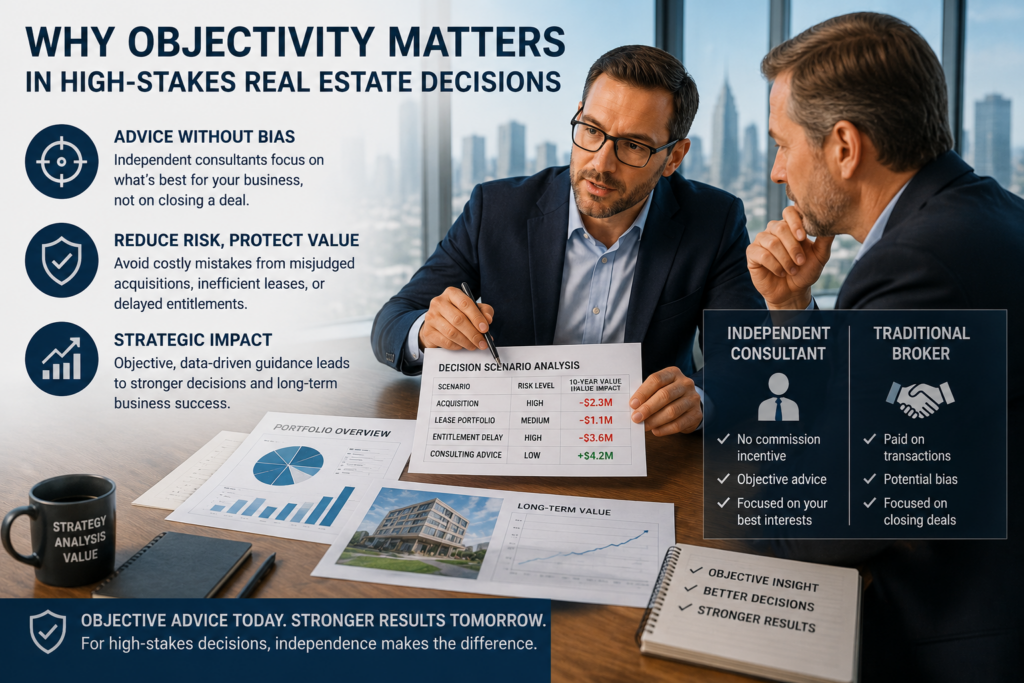
Why Objectivity Matters in High-Stakes Real Estate Decisions
The biggest advantage of commercial real estate consulting is the separation between advice and transaction. When a consultant isn’t chasing a commission, their recommendations are shaped purely by what’s best for the business.
This matters most when the stakes are high. A misjudged acquisition, an inefficient lease portfolio, or a stalled entitlement process can cost a company far more than a consulting fee ever would.
For routine transactions, a good broker is still the right resource. But for complex, high-dollar decisions that shape a company’s future, independent advice is worth the investment.
Final Thoughts
Commercial real estate consulting isn’t about replacing brokers. It’s about bringing in the right expertise at the right moment, especially when a decision involves significant financial risk or long-term strategic impact.
If your business is facing a portfolio overhaul, a major acquisition, or a complex capital structure, it may be time to bring in an independent consultant. Their objective, data-driven perspective can help you avoid costly mistakes and uncover opportunities you might otherwise miss.
Before your next major real estate decision, take a step back and ask whether the complexity of the situation calls for expert guidance. In many cases, the answer is yes.